
Admissions
Looking for a small, close-knit campus filled with incredible, hands-on learning opportunities? Our Admissions Office can help make Elmira College YOUR place.

Welcome
About EC
Getting Started
Academic Resources
Apply to EC
Visit Campus
Tuition & Financial Aid
Campus Life
Outcomes & Careers
Athletics
Alumni

Grounded in the liberal arts and sciences, Elmira College provides a collaborative and supportive environment that enables students to become active learners, effective leaders, responsible community members, and globally engaged citizens.

The legacy of academic excellence at Elmira College runs deep with a heritage and culture that have been forward-thinking from day one, as the first college for women with a course study equivalent to men's.
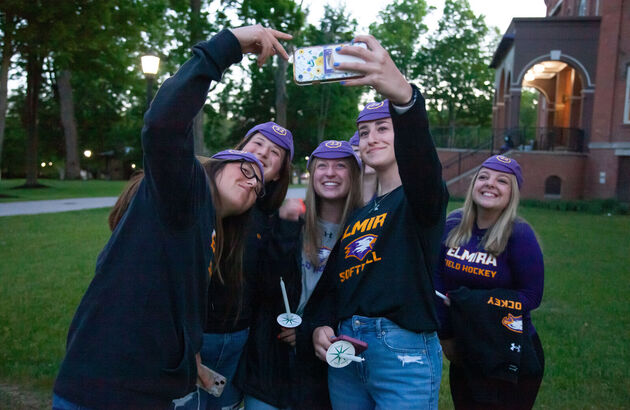
At Elmira, you’ll have opportunities that shape your future, raise your sights and equip you with targeted tools and skills to succeed in the professional world. Join a community that’s close-knit, fun-loving, and just the right amount of quirky.
Elmira College makes a private education more affordable than you realize, with a number of ways to get the financial assistance you may need. Our financial aid office can guide you through options, including scholarships, grants, loans, and work-study programs.

Elmira College includes meeting students from around the world, participating in Elmira traditions, completing community service projects, and hopping into a pickup kickball game.

Elmira College provides you with a foundation for future success.

The home of the three-time NCAA National Champion Elmira College Soaring Eagles.

Elmira College alumni stay connected and engaged with the College long after they graduate.

Gifts to Elmira College ensure excellent academic and co-curricular opportunities for generations of EC students.

Looking for a small, close-knit campus filled with incredible, hands-on learning opportunities? Our Admissions Office can help make Elmira College YOUR place.

Check out our news section to learn about all that's going on at Elmira College.

With over 35 majors and minor areas of concentration, Elmira College lays the foundation for a diverse, cross discipline education, encouraging you to both specialize and explore.

Looking for registration deadlines, spring break or when grades are due? Our academic calendar has all of the important events for this academic year.

The EC campus map can help you find your way around campus and find the best parking spot.
Internal dashboard for EC news, events, resources, and more. Log-in required.
Info For


Expectations for Students
Expectations for the College
Authority
Jurisdiction
Standard of Proof
College Policies and Procedures
Policies and Prohibited Conduct
Conduct Referral
Students' Bill of Rights
For current students who wish to download a PDF copy of the Code of Conduct, please visit MyEC.
Students are expected to abide by applicable laws and College policies and will be held accountable for their actions in accordance with the principles outlined in this Code of Conduct & Accountability. Explicit in these expectations is that students are responsible for making their own decisions and will accept the consequences of those decisions. Students are also responsible for complying with all other applicable College policies, including those governing sex-based discrimination, sexual harassment, and other conduct addressed under the Title IX Policy, which is summarized in this Code and incorporated into this Code of Conduct & Accountability by reference but is detailed in a separate policy that provides separate procedures.
The College, in general, will:
Authority over student conduct is vested in the Office of Campus Life, specifically the Chief Conduct Officer, who may take immediate action at their discretion for any violation of this Code of Conduct & Accountability. Conduct decisions issued by the Office of Campus Life resolve the matter unless appealed through the procedures specifically outlined in this Code. Students retain the right to appeal conduct decisions in accordance with the College’s appeal procedures, except in cases explicitly stated as non-appealable due to urgency or safety. The Chief Conduct Officer may delegate and exercise this authority consistent with this Code of Conduct & Accountability. The Chief Conduct Officer has the authority to take appropriate, interim actions to protect the safety and well-being of the Elmira College community (students, faculty and staff) and, where applicable, the broader public community.
The Office of Campus Life reserves the right to amend the College’s Code of Conduct & Accountability at any time, as deemed necessary, in which case the Chief Conduct Officer will notify the Elmira College community.
What is Covered: The College defines students as both graduate and undergraduate students, including clubs, organizations, and affiliated entities. Such organizations and their leaders and members may be held responsible for violations of this Code of Conduct & Accountability both collectively and/or as individual students, as deemed appropriate by the Chief Conduct Officer; all references to "students" in this Code apply equally to such organizations. Disciplinary action may result in rescission of permission and/or revocation of the organization to operate in connection with the College in any way.Students must abide by the Code of Conduct & Accountability from the time they are accepted to the College through their last date of attendance, and always while living in College-owned housing.
Scope of This Code: A student who violates College policies or fails to uphold accepted standards is subject to conduct action. The student Code of Conduct & Accountability applies to all properties owned, leased, or used by the College and conduct occurring in connection with any College program or activity, regardless of location. The College also reserves the right to take conduct action for incidents that occur off campus that adversely affect the health, safety, rights, educational environment, or operations of the College community.
Intersection with Law: Students are expected to abide by local, state, and federal laws. The institution will not provide sanctuary for those who violate such laws, and the College reserves the right to refer a student through the conduct process when a student has been charged with criminal violations. The College's policy is to submit any criminal investigation to the local police department or sheriff's office. This includes any criminal violation, misdemeanor, or violent felony criminal activity.
College's Investigatory Rights: The College reserves the right to confiscate and dispose of any items which are deemed to violate the College’s Code of Conduct & Accountability or to otherwise document such violations. The College reserves the right to conduct a search of student living spaces as set forth in the Housing Agreement and/or when reasonable suspicion exists that a violation of the Code of Conduct & Accountability or law has occurred, and such action is necessary to protect community safety or ensure policy compliance.
Elmira College uses a preponderance of the evidence standard in all student conduct matters which means the determination will be made on the basis of whether it is “more likely than not” that a student violated the Code of Conduct & Accountability. This is often equated as “50.01%” or “50 + a feather”. This standard applies to all prohibited conduct within the scope outlined above in this Code, regardless of circumstance or location.
Rules for the Maintenance of Public Order
In compliance with Education Law Section 6430 of the Laws of the State of New York, Elmira College hereby adopts the following “Rules for the Maintenance of Public Order” which shall apply to all members (students, faculty, and staff) and organizations of the College community as well as visitors, guests, licensees, independent contractors, and invitees to college-sponsored activities on college-owned or College operated property. Nothing contained in these rules is intended, nor shall it be construed, to limit or restrict the freedom of speech or right to peaceful assembly. The Board of Trustees hereby authorizes the President of the College or President’s designee to enforce these rules as provided.
Freedom of Speech and Peaceful Assembly
Elmira College supports the rights of all members of our community to express their views and to peacefully and lawfully protest actions and opinions with which they disagree. Yet the right to free speech and expression is not absolute. The U.S. Supreme Court has made several exceptions to the expression of free speech, and some forms of speech may be limited, banned, or prosecuted. These include obscenity, defamatory speech such as libel or slander, threats of violence to a person or group of people, false advertising, and what are called “fighting words,” or speech that is meant to incite an immediate retaliation from the audience.
Elmira College bans these types of speech. In addition, human and civil rights laws, including the New York State Human Rights Law and Title VI of the Civil Rights Act of 1964, demand that institutions maintain a harassment-free environment for all students and employees, specifically those who belong to one of the protected classes named in these statutes. Elmira College students, faculty, and staff are expected to uphold the values that drive the College’s mission to provide a collaborative and supportive environment that enables students to become active learners, effective leaders, responsible community members, and globally engaged citizens. Each member of the Elmira College Community is expected to balance their right to freedom of speech with the need to maintain a civil and secure environment where faculty, staff, and students can freely exchange ideas and openly engage in deliberation, debate, and learning. All members of the EC Community and visitors shall comply with this Policy. This Policy is considered part of the conditions of employment and participation in EC sponsored events or programs. This Policy applies to speech and expression that takes place on the EC campus, at EC sponsored events or programs off campus, and while employees and students are traveling and/or studying abroad.
This policy also applies to speech and expression that occurs on electronic resources (e.g., EC computers and elmira.edu email accounts) and EC owned/maintained social media sites (e.g., Facebook, Instagram, and Twitter). Members of the Elmira College community who do not conform to this policy will be subject to disciplinary action as outlined in the Student Code of Conduct (pgs. 19-25) and Employee Handbook (pgs. 69-73). Violating these terms may also open the speaker to legal action off campus. Freedom of speech is a cherished and important part of American society and is central to the mission of higher education. Elmira College is committed to supporting speech of all sorts, including speech that might be seen as offensive or unpopular. However, the College is also committed to protecting the rights of members of its community to enjoy an educational experience that is free from harassment. From its founding, Elmira College has been committed to supporting its students’ rights to expression, debate, and the free and respectful exchange of ideas; it continues to support those rights today.
Violations
The following actions are prohibited:
Applicability
These Rules shall apply to all persons, including students, employees (faculty, staff, or administrators), clubs, organizations and affiliated entities, visitors, guests, licensees, independent contractors, or invitees, organizing and/or participating in any college sponsored activity or on any college owned operated property, or on any other property or facility used by Elmira College.
Violations of these rules by faculty and/or staff, or administrators will be addressed by the appropriate vice president and may result in the rescission of permission to use college-owned, leased, or operated property for future events.
Visitors, including guests, licensees, independent contractors, or invitees, shall at all times conduct themselves in a manner that is consistent with the Rules for the Maintenance of Public Order on college premises, and their privilege to remain on college property shall automatically terminate upon breach of these Rules. The College, in addition, reserves the right to withdraw, at any time, the privilege of an independent contractor, invitee, or licensee to be on college premises. A trespasser has no privilege of any kind to be on college property but is nevertheless subject to these Rules governing the maintenance of public order.
Removal from Premises
Any person while on college-owned or college-controlled premises who violates these Rules or refuses the request or command of an authorized Elmira College official to desist in any prohibited conduct may be ejected from the entire campus, from the property being utilized for an event, or any such premises where the conduct constitutes a substantial danger to public order on such premises.
Penalties
All the penalties listed below will be in addition to possible removal from campus and any criminal penalty under the penal law or any other law to which a member of the campus community, visitor, guests, licensee, independent contractor, or invitee may be subject to.
Students: In the case of a student violator, penalties may include suspension, expulsion, or other appropriate disciplinary action in accordance with the Student Code of Conduct & Accountability. Individual student violations of the Rules will be heard through the College judicial system as constituted in section “Student Code of Conduct & Accountability”, subject to the range of possible sanctions therein.
Faculty, Staff or Administration: In the case of a violation by an individual member of the faculty, staff, or administration, penalties for violations may include suspension or termination from employment, or other appropriate disciplinary action in accordance with the respective policies covering the individual.
Non-community members: Violations by non-community members, including invited or uninvited guests, licensees, or invitees, will result in the offender’s immediate removal from the campus and possible criminal prosecution and/or permanent barring from the premises.
Organization: If a recognized or unrecognized club or organization authorizes conduct in violation of these Rules, penalties may include rescission of permission for that organization to operate in any way connected to the College.
Good Samaritan/Amnesty Policy
If Residence Life, Campus Safety, or other emergency personnel are contacted to provide emergency care to an intoxicated or impaired student, the individual who sought assistance may not face disciplinary sanctions—even if their own alcohol or drug use is revealed—provided the intent was to help another student in need.
Missing Student Policy
It is the policy of Elmira College to investigate any report of a missing student who is enrolled and attending classes. This policy, with its accompanying procedures, establishes a framework for cooperation among members of the College community aimed at locating and assisting students who are reported missing.
A student is deemed missing when absent from the College, including during trips, athletic events, or other off-campus programs and activities of the College, without known reason. All reports must be immediately directed to Campus Safety at 607-735-1777. Campus Safety will lead the investigation in collaboration with Campus Life staff and determine the student’s status.
Students may designate a confidential contact, to be notified within 24 hours if they are determined missing. This can be submitted via MyEC. Only the Dean of Students or designee, and law enforcement officials may access this information.
If the missing student is under 18 and not emancipated, their custodial parent or guardian will be notified within 24 hours of a confirmed missing status, in addition to notifying any additional contact person designated by the student. The College will notify local law enforcement within 24 hours of any report.
Elmira College will contact local police and other law enforcement agencies no later than 24 hours after the institution receives a report that any student is missing.
Given the various housing options at Elmira College, there is no formal procedure or prescribed timelines for monitoring whether students are present in their assigned student housing. Student welfare and safety is paramount to Elmira College; however, the institution recognizes and makes known its limitations in obtaining accurate and timely information on the whereabouts of students.
The Office of Campus Life shall have the responsibility to make the provisions of this policy and the procedures set forth below available to students.
Procedures:
Any report of a missing student, from whatever source, must immediately be directed to the Office of Campus Safety.
When a student is reported missing, the Office of Campus Safety will:
1. Initiate an investigation;
2. Inform the Office of Campus Life;
3. Determine the status of the student;
4. Notify local law enforcement within 24 hours;
5. If the student is missing from a trip or other off-campus activity or program sponsored by the institution, the Office of Campus Safety, in collaboration with the staff member on the trip, will contact local law enforcement.
Upon determining the student is missing, the Office of Campus Life will:
1. Notify the student's confidential contact within 24 hours of making the determination that the student is missing;
2. Notify the parent/guardian (if under 18 and not emancipated);
3. Inform Senior Officers;
4. Take any additional actions in the student's best interest.
Student Contact Information
In addition to having the option to identify a “confidential contact person” as provided in this policy, all students are asked to submit emergency contact information and update it yearly. The Office of Residence Life will verify and collect emergency contact information from residential students during fall move in.
Student Notification of This Policy:
Residential Age Policy
The College defines the residential student age range as ages 17-26. Students outside this range may request on-campus housing, which will be considered on a case-by-case basis by the Office of Residence Life.
Commuter Policy
Students must obtain permission from the Associate Dean of Students to live off campus. Students may automatically qualify for off-campus residency if they meet one or more of the following criteria:
Bicycles Policy
Bicycles must be stored overnight in the Meier Hall archway storage room. Daytime use may include racks across campus. Register your bicycle with Campus Safety to receive storage room access via your Student ID. Bicycles chained to fences, light posts, or stored in building interiors will be removed.
Parking Permits, Regulations & Registration Policy
All students and employees must register their vehicles within one week of arrival or within 24 hours of bringing the vehicle to campus. Register at the Campus Safety Office (710 Park Place, Elmira, NY 14901) or through MyEC. It is strongly recommended that all students and employees park in College-provided parking lots. The College reserves the right to limit issuance so as to prevent exceeding the number of available spaces.
Registration requirements:
1. Valid N.Y.S. license and registration;
2. A vehicle must be operated by and registered to the applicant or a family member.
Sticker Policy:
Parking Regulations
Parking in the following places is prohibited at all times:
1. Sidewalks, crosswalks, grass/lawns;
2. Driveways, doorways, or steps;
3. Fire lanes, hydrants, loading zones;
4. Unauthorized inner-campus roads;
5. Reserved spaces (e.g., Facilities, Auction Winners, Residence Life);
6. Disability access spots without proper permits.
Only authorized College vehicles and emergency vehicles (patrol cars, ambulances, fire trucks) are authorized to drive on the inner campus roadways and walks. Insurance and safety regulations forbid parking of automobiles, motor scooters, and motor bikes inside or under cover of any building or extension of such a building.
Any vehicle on college property including but not limited to campus parking lots in violation of the above rules and parking regulations or not registered with Campus Safety is subject to being towed, at the vehicle owner’s expense.
The fines may be imposed upon any person subject to these rules and regulations for any violations listed on the parking ticket. The registering of a vehicle at the College is held to constitute an agreement on the part of the registrant to abide by the College rules and regulations with regard to traffic and parking. All fines are to be paid at the Business Office located in McGraw Hall. Tickets not paid within ten days of issuance are subject to a $10 late fee charge.
Parking Violation - Fines
Fines are detailed in the Parking Violation ticket received if a violation of the parking regulations occur. Review the list of fines for your reference including, but not limited to:
Parking Violation Appeals
Appeals must be submitted in writing within three (3) business days of the violation. Appeal forms are available at the Campus Safety Office.
1. First appeal: Director of Campus Safety
2. Second appeal (if denied): Dean of Students, within three (3) business days of the Director's decision
City of Elmira Odd-Even Parking Ordinance
The Elmira Police Department enforces an odd-even parking ordinance on city streets. Under this ordinance the following parking restrictions apply for the entire year:
Note: this does not apply where parking is otherwise restricted by signs and where parking is restricted or prohibited on one side of the street for a full city block. Questions may be directed to the Campus Safety or Elmira Police Department Traffic Bureau, 607-737-5640.
Reserved Disability Access Parking - Elmira College will only honor disability parking permits issued by the Department of Motor Vehicles or by Town Clerks.
Temporary Permits - permits valid in designated lots stated on the permit are issued to short-time staff and departments needing temporary parking in restricted areas.
Visitor Spaces – Parking spaces reserved for visitors are reserved 24 hours a day. Vehicles with current parking stickers are prohibited from parking in spaces reserved for visitors at all times.
Wellness Check Response Policy
The institution is committed to maintaining a safe and supportive living and learning environment. When wellness checks are conducted due to concerns about a student’s safety or well-being, the following tiered response model will guide staff actions:
Note: Wellness checks are not disciplinary in nature. However, referrals to the student conduct process may also occur if potential policy violations are present. The purpose of this model is to balance student care with community safety, ensuring consistent response while connecting students to appropriate support services.
Elmira College Policy Statement on Alcohol
The College strives to maintain an academic environment that respects individual freedom while promoting the health, safety, and welfare of all community members.
In alignment with New York State law, the College has established policies governing the possession, consumption, and distribution of alcoholic beverages on campus. The College also sponsors educational programs that increase awareness of the physical, psychological, social, and behavioral effects of alcohol use.
Elmira College encourages students to make informed and responsible decisions regarding alcohol consumption. The College supports healthy, lawful, and safe social interaction and provides resources and assistance for students experiencing alcohol-related challenges. The misuse of alcohol is not tolerated, regardless of the student’s age.
The College’s primary responsibility is to preserve an environment conducive to academic success and personal development. All students have the right to quiet residential spaces, including on weekends.
Students are expected to behave respectfully and in ways that do not:
Elmira College is committed to educating students on risk-reduction strategies related to alcohol and other drug use. Staff will provide opportunities for students to develop responsible approaches to social situations involving these substances. This policy includes campus-wide education on the signs and symptoms of substance misuse, including overdose.
If students are experiencing alcohol-related difficulties, the College will provide support on campus and referrals to external resources as needed.
On-Campus:
Off-Campus:
Title IX Policy
All students are protected against any act of sexual misconduct, including sexual harassment, sexual assault, domestic and dating violence, and stalking, and each student has the right to exercise legal processes to address and resolve acts of sexual misconduct at Elmira College. If you (or someone you know) may have experienced a sexual assault or unwanted sexual contact of any kind, tell someone what happened. Help and support are available.
Cases involving allegations under Title IX and other forms of sexual misconduct are processed under the College’s Title IX Policy and are not governed by the disciplinary procedures outlined in this Code.
Failure to comply with sanctions or directives issued through the Title IX process may be addressed under the Code of Conduct & Accountability.
Title VI Policy
Elmira College is committed to maintaining an educational and working environment that is free from discrimination and harassment. Consistent with Title VI of the Civil Rights Act of 1964 and other applicable federal, state, and local laws, Elmira College prohibits discrimination on the basis of race, color, or national origin in any of its educational programs, activities, admissions, or services. This necessarily includes all operations that receive federal financial assistance under Title VI.
Discrimination prohibited by this policy includes unequal treatment, harassment, intimidation, retaliation, or the denial of benefits or opportunities based on an individual’s actual or perceived race, color, or national origin. National origin discrimination may include discrimination based on ethnicity, shared ancestry, shared ethnic characteristics, accent, or limited English proficiency, where prohibited by law.
Retaliation against any individual for reporting alleged discrimination, participating in an investigation, or exercising rights protected under Title VI is strictly prohibited.
Any student, employee, applicant, or third party who believes they have experienced or witnessed conduct that may constitute discrimination prohibited by Title VI is encouraged to report the matter promptly. Reports may be made to the College’s Title VI Coordinator or through any reporting mechanisms established by the College.
The College will review all reports in a prompt, fair, and impartial manner consistent with applicable law and institutional policy. If the College determines that further action is warranted, the matter will be referred to the appropriate institutional process. Complaints against students will generally be addressed through the Student Conduct & Accountability process, while complaints against employees will generally be addressed through the College's Human Resources policies and procedures.
Individuals are not required to confront the alleged offending party before making a report.
The College will take appropriate steps to prevent, address, and remedy conduct found to violate Title VI. Supportive measures may be offered, as appropriate and reasonably available, regardless of whether a formal complaint is filed.
Alcohol Policy
Animals and Pets
Students are not permitted to have animals or pets on campus unless in approved pet-friendly housing or in compliance with disability law.
The following exceptions apply:
Note: Meier Hall only permits fish; no other animals are allowed.
To apply for pet-friendly housing, contact the Office of Residence Life.
The following behaviors are strictly prohibited:
Arson
The willful, intentional setting of a fire to a structure, property, or vehicle.
Bias-Related or Hate Crime
A criminal act that intentionally targets a victim based on the victim’s actual or perceived race, color, national origin, ancestry, gender, gender identity or expression, religion, religious practice, age, disability, or sexual orientation.
Bullying
Bullying includes the infliction of physical, verbal, or psychological harm through teasing, threats, intimidation, stalking, harassment, physical violence, or property destruction. Bullying may occur in person or through electronic communication.
Complicity
Acts of complicity; aiding, abetting, attempting, conspiring, hiring, willfully encouraging or being an accessory to any violation of Code of Conduct & Accountability.
Conduct that Threatens Health or Safety
Conduct that causes, attempts to cause, or threatens immediate physical harm to oneself or another person, including physical violence, credible threats, severe impairment, or other behavior that poses a direct and significant danger to health or safety.
Discrimination
Discrimination on the basis of the following protected classes: race, color, national origin, religion, creed, age, disability, sex, gender identity or expression, sexual orientation, familial status, pregnancy, predisposing genetic characteristics, military status, domestic violence victim status, criminal conviction, or any other characteristics protected under federal or state law will not be tolerated and will be adjudicated through the official student conduct process.
Disorderly Conduct
Behavior that disrupts, interferes with, or unreasonably disturbs the normal operations of the College or the rights of others, including but not limited to excessive noise, disruptive behavior, or conduct that interferes with teaching, learning, administrative functions, or residential living.
Endangerment
Any reckless or negligent action that creates a substantial risk to the health, safety, or well-being of oneself, another person, or the community, regardless of whether injury actually occurs.
Failure to Comply
Falsification of Information
Furnishing false or misleading information to the College, or engaging in other forms of dishonesty, including:
Gambling
Participating in or offering any game of chance for money or personal gain in violation of New York State law.
Hall Sports
Engaging in sports or physically active games in residence halls, hallways, stairwells, or other indoor common spaces—except in designated recreational areas or with College-provided equipment in approved lounges.
Harassment
Repeated or severe non-sexual conduct that creates an intimidating, hostile, or unsafe environment for another person.
Hazing
Hazing includes any group or individual action that endangers the mental or physical health or safety of a person, or causes embarrassment, degradation, or humiliation—regardless of intent, location, or consent. Refer to Stop Campus Hazing Act for additional context.
Hazing is prohibited even if not a condition of initiation or membership, and applies to all members (active, new, prospective, or otherwise) of a group or organization. Examples include, but are not limited to:
Illegal Drugs
The unlawful manufacture, distribution, possession, or use of controlled substances, including misuse of prescription medication and possession of drug paraphernalia, is prohibited.
Marijuana use is not permitted on campus, regardless of state law. As a recipient of federal funding, Elmira College must comply with federal law, which classifies marijuana as a Schedule I controlled substance. This includes both medical and recreational marijuana use.
Irresponsible Social Conduct
Failure to uphold responsible social behavior that reflects positively on the Elmira College community, whether in person or online. Students are expected to demonstrate good citizenship both on and off campus.
Posting Policy
Any paper advertisements, flyers or posters for posting on campus must be approved and stamped by the Office of Campus Life. Events are limited to 20 copies and may only be posted in designated areas.
Prohibited Items or Actions
Students found in possession of prohibited items or engaging in the below prohibited actions will be fined $25 per violation. The charge will be automatically added to the student’s billing account when items are noted and/or confiscated by the Office of Residence Life or other College personnel. This fine is in addition to costs related to damage or other conditions of the residence hall, as outlined in the Housing Agreement, or other reasonable costs to make repairs for issues in non-residential facilities.
The following items/actions are strictly prohibited:
Quiet Hours
Quiet hours in all residence halls are defined as:
Courtesy hours are in effect 24/7, meaning residents must be respectful of noise levels at all times. During final examination periods, 24-hour quiet hours will be strictly enforced in all residential areas.
Per Elmira City Code, audible noise after 10:00 p.m. constitutes a noise ordinance violation. Therefore, all large outdoor gatherings must end by 9:59 p.m., including but not limited to:
Residential Guest Policy
A “guest” is defined as:
Guests may stay on campus for up to three nights within a seven-day period, and no more than twice per month, provided all roommates approve. The College reserves the right to deny or remove guests from campus at their discretion. Guests who perpetually violate the College Code of Conduct & Accountability may be permanently banned from campus.
All overnight guests must be pre-registered with the Office of Residence Life before their arrival. Registration forms are available through the assigned Resident Assistant and on MyEC.
Other guest policies are as follows:
Retaliation
Retaliation by or against students, staff, faculty, administrators, or any other individual involved in a College investigation is strictly prohibited. This includes, but is not limited to:
Room Key Responsibility/Lockout Fee
Students are responsible for the room key assigned to them at check-in. Lost keys incur a $100 replacement fee.
Lockout assistance will result in an escalating fee schedule, starting at $5 per incident, doubling with each subsequent lockout. Fees reset at the start of Term I and Term II.
Room Responsibility and Community Charges
Residents are responsible for damages, prohibited items, and policy violations occurring within their assigned room, suite, cottage, and shared common areas. Residents may also be held responsible for the actions of their guests.
Students must submit a completed Room Condition Report (RCR) within 24 hours of check-in. Failure to do so may limit or waive the student’s ability to dispute damage charges unless otherwise approved by the Office of Residence Life.
Damage charges to shared community spaces may be divided among residents when individual responsibility cannot be determined. Students may request a review of assessed charges through the Office of Residence Life. A minimum administrative charge of $25 may apply to community damage assessments.
At the end of the academic year, students are required to fully vacate their assigned space, remove all personal belongings, and dispose of trash in designated disposal areas. Failure to properly clean or vacate the space may result in cleaning, disposal, or removal charges.
Sexual Misconduct incl. Sexual Harassment, Sexual Assault, Domestic/Dating Violence, and Stalking
Refer to the Title IX Policy.
Shirt/Shoes Requirements
Students must wear both a shirt and shoes when entering public buildings, including classrooms, administrative offices, the Campus Center, Clarke Health Center, and Gannett-Tripp Library.
Smoking & Electronic/Vapor Smoking Policy
Elmira College is a smoke-free campus. Smoking and vaping are prohibited on all College grounds, including the Murray Athletic Center.
Solicitation
Solicitation and business operations on campus are subject to strict regulation:
Tampering with Safety Equipment
Tampering with, misusing, or falsely activating safety equipment is strictly prohibited and includes:
Violations will result in disciplinary action, and may also incur College and/or civil penalties, as the safety of our community is paramount.
Theft
Theft includes, but is not limited to:
Unauthorized Use, Entry, or Exit
The following actions are prohibited:
Unauthorized Use of the EC Network
Proper use of College IT resources follows the same standards of common sense and courtesy that govern the use of other public facilities. Therefore, the basic premise of the AUP is that College IT resources are permitted to be used in order to perform and/or support legitimate instructional and/or research activities and work.
Examples of improper use include, but are not limited to:
Uncivil Conduct
Uncivil conduct includes behavior directed toward another person that is intended to harass, intimidate, demean, alarm, or substantially interfere with that individual's ability to participate in the College community. This includes repeated unwanted communication through phone calls, text messages, email, social media, or other electronic means after being asked to stop.
Vandalism
Vandalism includes:
Violation of Federal, State, or Local Law
Any student conduct that violates federal, state, or local law is also a violation of College policy.
Weapons, Firearms and Explosives
Possession or use of weapons and explosives is strictly prohibited on all College property. This includes, but is not limited to:
Additionally, the use of any object as a weapon, or in a manner that could cause harm (e.g., throwing water balloons or cans), is prohibited.
Exception: Water balloons, Nerf guns, and snowballs are allowed only during College-sanctioned events and must be used outdoors only.
Overview
When a potential violation of College policy occurs, a College staff member will document the incident in a report. This report will include all individuals present at the time or, if no one is present, those who reside in the space, along with observed facts.
Once the report is submitted, the involved student(s) will receive a notification letter outlining the potential policy violation(s), details of the conduct process, and the name and contact information of the conduct officer or board assigned to review the case.
Incident reports may also be submitted by any member of the College community through the College’s website. The form can be found in the homepage of MyEC, or access directly here: Elmira College Incident Report Form
Reports should include the following:
The Chief Conduct Officer or their designee will review the report to determine the appropriate level within the conduct system for adjudication. Allegations that fall under the College’s Title IX Policy are referred to the Title IX Coordinator and are addressed through the procedures outlined in that policy rather than this Conduct Process.
Conduct Process
The College adjudicates conduct cases through various formats, including individual meetings, group meetings, and Conduct Committee hearings. The Chief Conduct Officer determines the appropriate format for each case. This process does not apply to matters governed by the Title IX Policy, which follow separate federally mandated procedures.
Administrative Hearings
Administrative hearings are conducted by a designated Conduct Officer—an administrator trained to investigate, adjudicate, and assign sanctions. These hearings provide an opportunity to:
The outcome of an Administrative Hearing is for such a Hearing Officer to make conduct decisions and impose sanctions up to conduct warning (as hereinafter defined.)
Administrative Hearing Officers are annually appointed by the Chief Conduct Officer. An Administrative Hearing Officer serves as a conduct agent of the College. The Chief Conduct Officer may appoint individual college administrators to serve in the capacity of Administrative Hearing Officers.
Conduct Committee
The Conduct Committee is authorized to deal with violations of the College’s rules and regulations. The Conduct Committee is authorized to impose sanctions, including expulsion (as hereinafter defined) in appropriate situations. The Conduct Committee is composed of members of the College’s Administration who have been trained to investigate, adjudicate, and sanction violations of the Code of Conduct & Accountability.
Hearing Procedures
Once an incident report is submitted, the following steps occur:
Hearing Rights
All students involved in a conduct hearing will be given the opportunity to:
Notification to Parents Regarding Illegal Alcohol and Illegal Drug Use by Students
Elmira College recognizes that college is a time of personal growth and exploration. At the same time, alcohol and controlled substance use can result in serious harm to students and the campus community.
In accordance with the Family Educational Rights and Privacy Act (FERPA) (20 U.S.C. §1232g; 34 CFR Part 99) and New York Education Law §6438-d, Elmira College maintains the following policy regarding notification of parents, guardians, or designated emergency contacts when students under the age of 21 are involved in alcohol- or controlled substance-related incidents.
Elmira College makes its policy on parental, guardian, or emergency contact notification publicly accessible in accordance with Education Law §6438-d through Elmira College official publications and institutional websites.
For students under the age of 21, Elmira College may notify a parent, guardian, or designated emergency contact when a student is found responsible for:
Notification decisions are made on a case-by-case basis by the Chief Conduct Officer or their designee. The College considers relevant circumstances, including but not limited to:
Lower-level violations (such as alcohol confiscation or underage possession/consumption without aggravating circumstances) typically do not result in notification.
Medical emergencies involving students of any age that involve alcohol or controlled substances, including hospitalization or overdose, will generally result in notification to parents or guardians or other emergency contacts, consistent with FERPA’s health and safety emergency exception which permits disclosure when necessary to address the health and safety emergency.
For students under 18 years of age, Elmira College will notify a parent or legal guardian of any violation of law or College policy involving alcohol or controlled substances.
In accordance with FERPA (20 U.S.C. §1232g; 34 CFR Part 99) and New York Education Law §6438-d, Elmira College provides regular training to relevant administrators and staff, including on-call personnel and student conduct professionals.
This training includes:
Training is conducted on a recurring basis as determined by the College and is incorporated into existing FERPA and student conduct training programs.
Role of the Advisor
Students may choose one advisor from among eligible College staff or faculty members to assist them during conduct proceedings. Eligible advisors may include, but are not limited to, academic advisors or coaches; however, these individuals are not automatically assigned to serve in this role. Advisors may not be related to any student involved in the proceeding, even if they are otherwise eligible to serve as an advisor.
Students may ask their advisor to:
Advisors are not automatically included in Conduct Committee proceedings. It is the student’s responsibility to identify and invite an advisor and to notify the Conduct Hearing Officer at least 24 hours in advance of any meeting or hearing the advisor will attend.
Advisors do not have access to conduct records and must receive any necessary information directly from the student. Advisors do not participate in decision-making and may not speak or act on behalf of the student during any meeting or hearing. The student is responsible for presenting their own information and responding to questions.
Students are encouraged to use their advisor for guidance, preparation, and support throughout the conduct process.
For more information about the role of an advisor, students may meet with their assigned Conduct Hearing Officer.
Examples of Conduct Sanctions
The level of sanction will depend on the nature of the violation and will also consider the individual’s conduct history. The following list of sanctions is not exhaustive. Conduct agents may impose any single sanction, a combination of sanctions, or any not prohibited by State and Federal Law.
Disciplinary Holds
The Chief Conduct Officer (or designee) will place a student conduct hold on the records and registration of any student who fails to respond to a conduct notice or fails to complete a sanction as determined by the Conduct Committee. Any pending conduct matters must be resolved prior to re-registration or a student's graduation whichever comes first. No student will be allowed to register until the pending disciplinary matter(s) is/are resolved. Student conduct holds may also affect financial aid.
The Chief Conduct Officer or Dean of Students (or designee) will place a student conduct hold on the records and registration of a student that is under suspension or expulsion from the institution. The student conduct hold will not be removed until the student's suspension status has expired and/or the requirements as set forth by the Conduct Committee and Code of Conduct & Accountability for readmission have been successfully met. This determination will be made by the Dean of Students (or designee).
Transcript Notation for Violent Offenses
As required by state law, all colleges and universities in New York are required to denote conduct outcomes on academic transcripts of students suspended or expelled for any policy violation that is deemed a violent offense as defined by Clery Act reportable crimes, or who withdraws with such charges pending.
Transcript notations are applied at the conclusion of the conduct proceedings and appeals processes.
The law mandates that in such instances, colleges provide the following (as applicable) on an academic transcript:
If a student was suspended or withdrawn with charges and/or conduct investigation, the notation will remain on a transcript for a minimum of one year. After one years’ time, a student may request to have the transcript notation removed by filing an appeal with the Dean of Students. If an appeal is not filed, the notation will be removed after seven years. Notations for expulsion are not removable.
Transcript Notation Appeals Process
To file an appeal to have the transcript notation removed from an academic transcript a student must submit in writing to the Dean of Students the following:
Appeals will be reviewed and a decision will be provided in writing within thirty (30) College business days of submission.
Withdrawal Prior to Conduct Case Adjudication
A student who withdraws from the institution prior to an outcome of a pending conduct case should understand that the investigation will continue without their participation. A student can still be found responsible in their absence. Withdrawal from the institution will not protect a student from possible criminal or civil action(s).
Appeals Process
A request for an appeal must be submitted in writing within three (3) College business days of the outcome notification. The request for an appeal must clearly state the grounds on which an appeal is being requested and shall contain all appropriate supporting information to be considered as defined below.
Requests for an appeal may only be filed on the following grounds:
A request for an appeal of decisions and sanctions imposed by Administrative Hearing Officers are made to the Chief Conduct Officer. Requests for an appeal of decisions and sanctions imposed by the Chief Conduct Officer or the College’s Conduct Committee are made to the Dean of Students, unless otherwise noted. The results of the request will generally be sent in writing to the student within three (3) College business days of the date of the appeal. In instances when a decision to process an appeal request cannot be made within three (3) College business days, notification will be sent to the requestor.
When a request for an appeal is submitted, the Chief Conduct Officer or the Dean of Students will determine if the request meets the threshold for an appeal. The presumption is that an appeal will not be granted unless compelling justification is provided. When the request for an appeal is made, the Hearing Officer and/or Conduct Committee that heard the case and imposed the sanction will be notified of the appeal and have the ability to respond in writing to the claim they failed to follow the procedural requirements, or that there is new evidence available that was previously unavailable. The Hearing Officer and/or Conduct Committee will conclude whether or not the new information presented would have impacted their finding of the outcome. Based on this information, the decision to accept or deny the request for an appeal can be made.
If the appeal is accepted, the Chief Conduct Officer or Dean of Students may:
All appellate decisions are final. Students submitting an appeal should be aware that sanctions may be modified upward, downward, or remain unchanged.
Although a request to appeal a conduct sanction can be submitted as noted above, the sanction must be followed until such time as a response to the appeal is decided.
Interim Actions and Request for Appeals
Students who are alleged to have been involved in, or who are reasonably believed to have been involved in, a potential violation of the Code of Conduct & Accountability may be subject to an Interim Action when the College determines that immediate measures are necessary to protect the health, safety, welfare, educational environment, or operations of the College community.
Interim Actions are administrative measures intended to protect individuals and the College community and are not a determination that a student has violated College policy. Interim Actions may be imposed before the completion of the conduct process and will remain in effect pending resolution of the matter or until otherwise modified by the College.
Interim Actions may include, but are not limited to, contact restrictions with other individuals, housing relocations, restrictions from College activities or facilities, and Interim Suspension requiring temporary removal from College property and College-sponsored activities.
Students will be notified of an Interim Action in writing, which will include the rationale for the action. Once a student has been notified that an Interim Suspension is in effect and requires them to leave College property, the student is expected to leave College property within 30 minutes, unless otherwise directed by College officials. Residential students will have up to 30 minutes, under the direct supervision of College staff, to gather personal belongings from their room before leaving College property, unless otherwise directed by College officials.
If a student is unable to leave campus within the designated timeframe, the College may, at its discretion, provide temporary assistance in facilitating the student's departure from campus. Such assistance may include supervision by College personnel, transportation arrangements, communication with a parent, guardian, emergency contact, or other appropriate support person, and assistance in identifying temporary lodging options. Any costs associated with transportation, lodging, or other services provided on behalf of the student may be charged to the student's student account. The College is not responsible for securing or funding ongoing housing accommodations following an Interim Suspension.
If a student believes an Interim Action has been imposed in error or is no longer necessary, the student may submit a written appeal of the Interim Action to the Chief Conduct Officer within two (2) College business days of notification of the Interim Action. In situations where the Chief Conduct Officer imposed the Interim Action, appeals shall be submitted to the Dean of Students.
The review will be limited to whether the Interim Action remains reasonably necessary to protect the health, safety, welfare, educational environment, or operations of the College community. The review is not an appeal of the underlying allegations or a determination of responsibility. Interim Actions remain in effect throughout the appeal process. The filing of an appeal does not stay, postpone, or invalidate an Interim Action unless the College determines otherwise in writing.
A decision regarding the appeal will generally be provided in writing within three (3) College business days of receipt of the appeal. If additional time is required, the student will be notified of the delay and provided with an estimated timeline for resolution.
Return from Suspension
Students seeking return to campus after being placed on suspension:
1. Are eligible to apply after time away/date determined by sanctions.
2. Need to successfully complete all sanctions and meet all conditions to return as outlined in sanctions.
3. Must submit a thoughtful written request for reinstatement to the Dean of Students, demonstrating behavioral change, completion of required sanctions, and a plan for future success. If suspension was for drug/alcohol violations, evidence must include completion of a substance assessment or treatment plan.
4. If approved to return, will be placed on disciplinary probation for one (1) academic year upon return.
Rights of All Students
All students have the right to:
Rights in Cases Involving Sexual Assault, Domestic/Dating Violence, and Stalking
Anyone reporting an incident of sexual assault, domestic or dating violence or stalking has the right to: