
MyEC
Internal dashboard for EC news, events, resources, and more. Log-in required.

Welcome
About EC
Getting Started
Academic Resources
Apply to EC
Visit Campus
Tuition & Financial Aid
Campus Life
Outcomes & Careers
Athletics
Alumni

Grounded in the liberal arts and sciences, Elmira College provides a collaborative and supportive environment that enables students to become active learners, effective leaders, responsible community members, and globally engaged citizens.

The legacy of academic excellence at Elmira College runs deep with a heritage and culture that have been forward-thinking from day one, as the first college for women with a course study equivalent to men's.
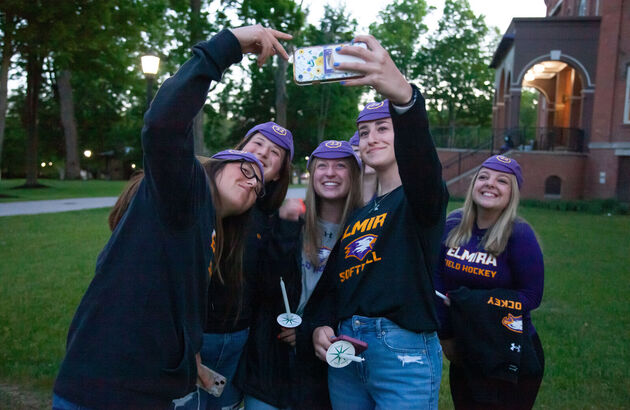
At Elmira, you’ll have opportunities that shape your future, raise your sights and equip you with targeted tools and skills to succeed in the professional world. Join a community that’s close-knit, fun-loving, and just the right amount of quirky.

Elmira College makes a private education more affordable than you realize, with a number of ways to get the financial assistance you may need. Our financial aid office can guide you through options, including scholarships, grants, loans, and work-study programs.

Elmira College includes meeting students from around the world, participating in Elmira traditions, completing community service projects, and hopping into a pickup kickball game.

Elmira College provides you with a foundation for future success.

The home of the three-time NCAA National Champion Elmira College Soaring Eagles.

Elmira College alumni stay connected and engaged with the College long after they graduate.

Gifts to Elmira College ensure excellent academic and co-curricular opportunities for generations of EC students.

Internal dashboard for EC news, events, resources, and more. Log-in required.

With over 35 majors and minor areas of concentration, Elmira College lays the foundation for a diverse, cross discipline education, encouraging you to both specialize and explore.

Check out our news section to learn about all that's going on at Elmira College.

The EC campus map can help you find your way around campus and find the best parking spot.

Looking for a small, close-knit campus filled with incredible, hands-on learning opportunities? Our Admissions Office can help make Elmira College YOUR place.

Looking for registration deadlines, spring break or when grades are due? Our academic calendar has all of the important events for this academic year.
Info For


Overview and Policy Summary
Reporting to a Responsible Administrator of the College
Confidential Resources
Supportive Measures and Emergency Removal of Students
Definitions
Timing of Reports
Standard of Proof
Sanctions/Discipline
Law Enforcement and Effect of Criminal Proceedings
The College's Grievance Process
Investigation Procedures
Hearing Procedures
As an educational institution, Elmira College is committed to promoting a campus environment where sexual harassment, sexual assault, and other inappropriate sexual contact, as well as dating violence, domestic violence and stalking, where it impacts or has the potential to impact the educational or employment environment of any member of the College community, is not tolerated. Some of the conduct prohibited by this policy is unlawful, and all of the prohibited conduct is antithetical to the mission of the College. Elmira College will take reasonable and appropriate remedial action to prevent Sexual Misconduct, prevent its recurrence, and correct its discriminatory effects on the complainant and others.
Elmira’s process to address cases of alleged sexual harassment and other forms of sexual misconduct is designed to consider the rights of the complainant, the rights of the respondent, the safety of the community, all applicable laws and College policies; and to conduct a timely, fair, impartial, and equitable investigation and adjudication process with thoroughness and respect for all involved parties.
As a recipient of federal funds, Elmira College is required to comply with Title IX of the Education Amendments of 1972, 20 U.S.C. & 1681 et seq., which prohibits discrimination on the basis of sex in education programs or activities. Pursuant to Title IX and the Violence Against Women Act (“VAWA”) and New York Education Law Section 129-B, the College also prohibits domestic/dating violence and stalking where it impacts or has the potential to impact the educational or employment environment of a College community member.
This policy applies to all students, faculty, and staff of Elmira College. This policy applies to conduct on-campus and in connection with any College-sponsored program or activity, regardless of where it occurs. Additionally, off-campus conduct may violate this policy if the conduct creates a threatening or uncomfortable work or learning environment on Elmira’s campus or within any College program, or if the incident causes concern for the safety or security of the College’s campus. Non-community members (e.g., alumni, family of students, vendors, etc.) visiting campus or participating in any College program or activity are expected to abide by the behavioral expectations in this policy. A Students’ Bill of Rights for cases involving sexual assault, domestic violence, dating violence or stalking, as well as an additional general statement of rights, is attached at the end of this policy.
This Policy prohibits all forms of sex and gender-related misconduct, referred to here, and defined more fully below, as “sexual misconduct”. A person who has experienced Sexual Misconduct has several options:
Additionally, the person who experienced a crime has the option to pursue criminal charges:
The options for reporting above are not mutually exclusive, and an individual may pursue one option but not the other. An individual may obtain the services of a confidential resource and decide at that time or a later time to report to the College.
Any Elmira student, staff member, or faculty member who wishes to report Sexual Misconduct may do so by contacting any one of the following specially trained individuals:
These individuals have been trained to receive and respond to allegations of violations of this policy. Complaints can be made by those who have been the victim of a violation of this policy, by a third party on a victim’s behalf or anonymously.
While certain other employees may also have a reporting obligation, if a complaint is made to anyone other than the Responsible Administrators listed above, the complainant risks the possibility that it will not come to the attention of the proper College officials and may, therefore, not be acted upon. For purposes of this policy, Faculty are NOT considered Responsible Administrators. In addition, unless a report is made to someone listed as a Confidential Resource, confidentiality cannot be assured.
Upon receiving a report, the Responsible Administrator to whom the report is made will discuss with the complainant available avenues and options. Options may include disciplinary action against the accused and remedial actions to ameliorate or correct the effects of the Sexual Misconduct. Other options may include interim changes in academic, residential, or working arrangements to separate the complainant and the accused or other measures to enhance the complainant’s safety, such as escorts or increased monitoring of an area.
The College will review the facts and circumstances of each case, as well the complainant’s wishes, in deciding whether and what steps are reasonable and appropriate.
A Responsible Administrator will share all information reported to him/her with the Title IX Coordinator and may share with other school administrators, as needed. A Responsible Administrator will similarly report Sexual Misconduct that he or she observes firsthand or learns about in any other manner. A Responsible Administrator is not a confidential resource. Although a person may disclose information concerning an incident to a Responsible Administrator and request that no investigation or disciplinary action be taken, the College may decide not to honor that request, depending on the circumstances. If a complainant requests that his/her identity be kept confidential but that an investigation and review for disciplinary action occur, the College’s decision will depend on whether the information provided by the complainant can be acted upon without revealing the complainant’s identity. If a complainant requests that no action be taken against the perpetrator, the College will consider the seriousness of the offense, whether there was a single perpetrator or multiple perpetrators, whether the circumstances suggest a risk to the campus community, and similar considerations. The College retains the right to act upon any information that comes to its attention. Requests for confidentiality will be decided by the Title IX Coordinator. Even if a complainant requests and/or is granted confidentiality, he or she may still have access to appropriate supportive measures on an interim or other basis. Even Elmira College offices and employees who cannot guarantee confidentiality will maintain a complainant’s privacy to the greatest extent possible. The information provided to a nonconfidential resource will be relayed only as necessary for the Title IX Coordinator to investigate and/or seek a resolution.
If an anonymous report is made to a Responsible Administrator, it will be investigated and appropriate action taken, to the extent practicable. Anonymity may impact the action the College may be able to undertake in response to the complaint. In all cases, the College will take appropriate steps to protect against retaliation.
Individuals who wish to make a report via the College's Incident Report form may do so:
Students or other community members who are not sure whether they want to make a formal complaint can still seek help from the confidential resources listed in this section. Contacting any of these confidential resources does not mean that the student must file an official report with the College or report the Sexual Misconduct to law enforcement, and in fact reporting to these confidential resources does not constitute reporting to the College (as a result, action by the College may not be taken) or to law enforcement. These resources are provided to offer nonjudgmental support and information to help an individual decide what is best for him or her as he or she recovers.
Reports to the Counselors and medical staff in the Clarke Health Center are confidential by law. As such, personally identifiable information should not be subject to disclosure under any circumstances. On-campus confidential services can be reached at:
The health and counseling services noted above are available to students free of charge. Confidential resources can provide a member of the campus community with information on medical and counseling services that may be available; academic, housing, and other support services that may be available (although some services may not be available if an individual wishes to maintain complete confidentiality); information regarding and assistance with the filing of formal complaints under this policy; and/or information regarding and assistance with contacting law enforcement.
A report to a Confidential Resource is not a report to the College and will not result in an investigation or disciplinary action. In addition, students or other members of the campus community may contact these resources on an anonymous basis, although anonymity may impact the assistance that can be provided.
There are also confidential off-campus resources which may be available to you; contacting the resources below does not constitute notifying the College. These resources include:
Supportive measures may be made by the College in an effort to immediately respond to a situation. Once a report is made under this Policy, the complainant will be contacted by the Title IX Coordinator and offered individualized support as more fully described below. A report that triggers supportive measures need not be a formal complaint, and it may be made by a third-party (i.e., someone other than the complainant himself/herself). Once the respondent is informed of a report or a formal complaint, the respondent will be contacted by the Title IX Coordinator and offered individualized support as more fully described below. Supportive measures are intended to restore or preserve, to the extent practicable, equal access to the College’s educational programs and activities and protect the safety of all parties without unreasonably burdening the other party or parties. As required by federal regulation, these supportive measures must be non-disciplinary and non-punitive to the parties.
Supportive measures could include, but are not limited to:
The Title IX Coordinator is responsible for coordinating the implementation of supportive measures, including coordinating with the various College departments and offices that may be involved. Supportive measures will be offered free of charge. If a party’s request for a supportive measure is denied, the party will be afforded an opportunity to have the denial promptly reviewed to assess whether the supportive measure is reasonable under the circumstances. In addition, each party will, upon request, be afforded the opportunity for a prompt review of the need for and terms of supportive measures that have been implemented, including the potential modification of these measures, to the extent that the party is affected by the measure(s) being reviewed. Each party will be allowed to submit evidence in support of, or in opposition to, the request to the extent the supportive measures under review affects that party. Information about how to request a review will be included in a written communication that will outline the supportive measures offered and any that were requested by the party but denied. Upon receipt of such a request, to the extent that the other party is affected by the measure(s) being reviewed, the Title IX Coordinator will inform the other party of the request and allow the other party to respond, including submitting evidence if desired. This review process will occur as soon as possible, but generally no later than five business days of the request and the parties’ submission of any evidence. The Title IX Coordinator in conjunction with the Vice President of Enrollment Management will enforce protective measures under College policy. Individuals who violate a “no contact order” or other supportive measures implemented by the College may be subject to conduct charges.
In some cases, the College may undertake an emergency removal of a student respondent in order to protect the safety of the college community, which may include contacting local law enforcement to address imminent safety concerns. Emergency removal is not a substitute for reaching a determination as to a respondent’s responsibility for the sexual harassment or other sexual misconduct allegations; rather, emergency removal is for the purpose of addressing imminent threats posed to any person’s physical health or safety, which may arise out of the sexual misconduct allegations.
Prior to removing a student respondent through the emergency removal process, the College will undertake an individualized safety and risk analysis. If the individualized safety and risk analysis determines that an immediate threat to the physical health or safety of any student, including the student respondent, or other individual justifies removal, then a student respondent will be removed. This is the case regardless of the severity of the allegations and regardless of whether a formal complaint was filed.
After determining a student respondent is an immediate threat to the physical health or safety of an individual, the Title IX Coordinator will provide written notice of the emergency removal to both the complainant and respondent. This notice will contain: (1) the date the removal is set to begin, (2) the reason for the emergency removal, (3) the consequences of non-compliance, and (4) how to appeal the decision. If a student respondent disagrees with the decision to be removed from campus, the respondent may appeal the decision. The respondent must provide written notice of the intent to appeal, which shall include the substance of the appeal, to the Title IX Coordinator within 10 days of receiving the notice of removal. The burden of proof is on the student respondent to show that the removal decision was incorrect.
This section applies only to student respondents. Employee respondents are not subject to this section and may be placed on administrative leave pursuant to the College’s policies and/or collective bargaining agreements during the pendency of a Title IX grievance process.
The College is committed to maintaining an environment that is free from sexual harassment and sexual violence and in which the freedom to make individual choices regarding sexual behavior is respected by all. Per state law, sexual activity requires affirmative consent as defined below in this policy.
Advisor of Choice — An advisor of choice is a person selected by the Complainant or Respondent to advise and accompany the Complainant or Respondent throughout the investigation and adjudication process. An advisor of choice may be any person, including an attorney. The institution does not appoint or pay for an advisor of choice. An advisor of choice’s role is limited to the functions further described in this policy.
Affirmative Consent — Elmira expects that any sexual activity or contact will be based on mutual affirmative consent to the specific sexual activity or sexual contact. All references to consent in this policy will mean affirmative consent which is defined as follows:
Affirmative consent is a knowing, voluntary, and mutual decision among all participants to engage in sexual activity. Consent can be given by words or actions, as long as those words or actions create clear permission regarding willingness to engage in the sexual activity. Silence or lack of resistance, in and of itself, does not demonstrate consent. The definition of consent does not vary based upon a participant's sex, sexual orientation, gender identity, or gender expression. Consent to any sexual act or prior consensual sexual activity between or with any party does not necessarily constitute consent to any other sexual act. Consent may be initially given but withdrawn at any time by expressing in words or actions that they no longer want the sexual act to continue. When consent is withdrawn or can no longer be given, sexual activity must stop.
Consent cannot be given when a person is incapacitated, which occurs when an individual lacks the ability to knowingly choose to participate in sexual activity. Incapacitation may be caused by the lack of consciousness or being asleep, being involuntarily restrained, or if an individual otherwise cannot consent. In New York, a person under the age of 17 is incapable of giving consent to any sexual activity. Depending on the degree of intoxication, someone who is under the influence of alcohol, drugs, or other intoxicants may be incapacitated and therefore unable to consent. Consent is required regardless of whether the person initiating the act is under the influence of drugs and/or alcohol. Consent cannot be given when it is the result of any coercion, intimidation, force, or threat of harm.
Coercion — Coercion is a threat, undue pressure, or intimidation to engage in sexual activity. Coercion is more than an effort to persuade, seduce, entice, or attract another person to engage in sexual activity. A person’s words or conduct are sufficient to constitute coercion if they deprive another individual of the ability to freely choose whether or not to engage in sexual activity.
Complainant — The term Complainant refers to the person who allegedly experienced the sexual misconduct in violation of the policy whether or not a formal complaint is filed. In some cases, the Title IX Coordinator may file a formal complaint and thereby initiate an investigation and adjudication process pursuant to this policy. In that instance, the Title IX Coordinator is not the “Complainant”; the complainant remains the person who allegedly experienced the sexual misconduct.
Formal Complaint — A formal complaint refers to a written complaint filed in accordance with the grievance process below. A formal complaint is necessary to initiate an investigation and adjudication process.
Institution Advisor — A Complainant or Respondent who does not opt to be accompanied by an advisor of choice at a hearing is entitled to be appointed an advisor by the College at no charge to the party. This advisor is referred to as an “institution advisor” who may be but need not be an attorney. The institution advisor is selected and assigned by the College. An institution advisor’s role is limited to asking cross-examination questions of the other party during a hearing. An institution advisor does not represent a party in any legal sense. The party is responsible for formulating the cross-examination questions the institution advisor will pose during the hearing.
Reporting Party — The term Reporting Party refers to the person making the report. That person is usually, but is not always, the person who experienced the harassment, sexual misconduct or other violation of this policy.
Respondent — The term respondent refers to the person alleged to have committed the alleged harassment or other sexual misconduct in violation of this policy.
Sexual Misconduct — The term “sexual misconduct” is an umbrella term used by this policy to more conveniently refer to any form of conduct prohibited by this policy. Sexual misconduct may occur between members of the same or opposite sex and in heterosexual or homosexual relationships.
This policy sets forth conduct expectations for our community and provides a process for the reporting, investigation and adjudication of alleged violations. This policy applies to alleged conduct violative of Title IX of the Education Amendments of 1972 (i.e., “Title IX Category” violations) and also applies to a broader range of contexts and behaviors inconsistent with the College’s commitment to equal opportunity (i.e., “College Category” violations).
The designation of conduct or allegations as either “Title IX Category” or “College Category” is not a function of the seriousness of the alleged conduct but rather a function of the scope and coverage of Title IX versus the College’s broader jurisdiction to prohibit and discipline a larger scope of inappropriate behavior.
Title IX Category Violations
Title IX of the Education Amendments of 1972 provides: “No person in the United States shall, on the basis of sex, be excluded from participation, be denied the benefits of, or be subjected to discrimination under any education program or activity receiving Federal financial assistance.” In accordance with Title IX as interpreted by the Department of Education, the College recognizes the following as conduct violations within the meaning of Title IX, provided that the context and circumstances of the conduct fall within the scope of Title IX, including but not limited to that the complainant was in the United States at the time of the alleged conduct, that the complainant be participating in or seeking to participate in the College’s education program or activity at the time of the complaint, and that the conduct have occurred in the context of the College’s education program or activity:
Sexual Harassment — “Sexual harassment” means conduct on the basis of sex that satisfies one or more of the following: a. An employee of the College conditioning the provision of an aid, benefit, or service of the College on an individual’s participation in unwelcome sexual conduct (commonly referred to as a “quid pro quo”); b. Unwelcome conduct determined by a reasonable person to be so severe, pervasive, and objectively offensive that effectively denies a person equal access to the College’s education program or activity (commonly referred to as a sexually or gender-based “hostile environment”).
Sexual assault — “Sexual assault” includes any sexual act directed against another person, without consent of the victim, including instances where the victim is incapable of giving affirmative consent. Sexual assault consists of the following specific acts: a. Rape. The penetration, no matter how slight, of the vagina or anus with any body part or object, or oral penetration by a sex organ of another person, without the consent of the victim. This offense includes the rape of both males and females. b. Non-Consensual Sexual Contact/Fondling. The touching of the private body parts (including genitalia, anus, groin, breast, inner thigh or buttocks) of another person for the purpose of sexual gratification, forcibly and/or against that person's will; or, not forcibly or against the person's will where the victim is incapable of giving consent because of their youth or because of their temporary or permanent mental or physical incapacity. c. Incest. Non-forcible sexual intercourse between persons who are related to each other within the degrees wherein marriage is prohibited by law. d. Statutory Rape. Non-forcible sexual intercourse with a person who is under the statutory age of consent. The statutory age of consent in New York is 17.
Dating violence — “Dating violence” means violence committed by a person: (1) who is or has been in a social relationship of a romantic or intimate nature with the victim; and (2) where the existence of such a relationship shall be determined based on a consideration of the following factors: (i) The length of the relationship. (ii) The type of relationship. (iii) The frequency of interaction between the persons involved in the relationship.
Domestic violence — “Domestic violence” means violence committed by a current or former spouse or intimate partner of the victim, by a person with whom the victim shares a child in common, by a person who is cohabitating with or has cohabitated with the victim as a spouse or intimate partner, by a person similarly situated to a spouse of the victim under the domestic or family violence laws of the jurisdiction where the College is located, or by any other person against an adult or youth victim who is protected from that person’s acts under the domestic or family violence laws of the jurisdiction.
Stalking — “Stalking” is engaging in a course of conduct on the basis of sex directed at a specific person that would cause a reasonable person to: (1) fear for his or her safety or the safety of others; or (2) suffer substantial emotional distress. Stalking that does not occur on the basis of sex may be addressed under as a College Category Violation as described below.
College Category Violations
The College prohibits the following behavior. For purposes of College Category violations, the conduct below is prohibited even if the conduct occurs off-campus, outside the United States, the Complainant is not participating in or seeking to participate in the College’s education program or activity, or otherwise in circumstances over which the College does not have influence or control, including but not limited to during college academic breaks. The College retains discretion to not respond to, investigate or adjudicate circumstances in which no College interest is implicated.
Sexual harassment — “Sexual harassment” means unwelcome, offensive conduct that occurs on the basis of sex, sexual orientation, self-identified or perceived sex, gender, gender expression, gender-stereotyping or the status of being transgender, but that does not constitute sexual harassment as a Title IX Category Violation as defined above. Sexual harassment can be verbal, written, visual, electronic or physical. The fact that a person was personally offended by a statement or incident does not alone constitute a violation. Instead, the determination is based on a “reasonable person” standard and takes into account the totality of the circumstances.
Sexual assault — “Sexual assault” includes any sexual act directed against another person, without consent of the victim, including instances where the victim is incapable of giving affirmative consent, but that does not constitute sexual assault as a Title IX Category Violation as defined above because of the context in which it occurs (for example because the complainant was not in the United States at the time of the alleged conduct, because the complainant was not participating in or seeking to participate in the College’s education program or activity at the time of the complaint, or because the conduct did not occur in the context of the College’s education program or activity). Sexual assault consists of the following specific acts:
Dating violence — “Dating violence” means violence committed by a person: (1) who is or has been in a social relationship of a romantic or intimate nature with the victim; and (2) where the existence of such a relationship shall be determined based on a consideration of the following factors: the length of the relationship; the type of relationship; and the frequency of interaction between the persons involved in the relationship; but that does not constitute dating violence as a Title IX Category Violation as defined above because of the context in which it occurs (for example, because the complainant was not in the United States at the time of the alleged conduct, because the complainant was not participating in or seeking to participate in the College’s education program or activity at the time of the complaint, or because the conduct did not occur in the context of the College’s education program or activity).
Domestic violence — “Domestic violence” means violence committed by a former spouse or intimate partner of the victim, by a person with whom the victim shares a child in common, by a person who is cohabitating with or has cohabitated with the victim as a spouse or intimate partner, by a person similarly situated to a spouse of the victim under the domestic or family violence laws of the jurisdiction where the College is located, or by any other person against an adult or youth victim who is protected from that person’s acts under the domestic or family violence laws of the jurisdiction, if the conduct does not constitute domestic violence as a Title IX Category Violation as defined above because of the context in which it occurs (for example because the complainant was not in the United States at the time of the alleged conduct, because the complainant was not participating in or seeking to participate in the College’s education program or activity at the time of the complaint, or because the conduct did not occur in the context of the College’s education program or activity).
Stalking — “Stalking” is engaging in a course of conduct directed at a specific person that would cause a reasonable person to: (1) fear for his or her safety or the safety of others; or (2) suffer substantial emotional distress, but that does not constitute stalking as a Title IX Category Violation as defined above because of the basis on which it occurs or the context in which it occurs (for example because the complainant was not in the United States at the time of the alleged conduct, because the complainant was not participating in or seeking to participate in the College’s education program or activity at the time of the complaint, or because the conduct did not occur in the context of the College’s education program or activity).
Sexual Exploitation — Sexual exploitation occurs when, without affirmative consent, a person takes sexual advantage of another in a manner that does not constitute another violation under this Policy. Examples of sexual exploitation include, but are not limited to: prostitution, acts of incest, observing or recording (whether by video, still photo or audio tape) of a sexual or other private activity (such as consensual sexual activity, undressing or showering) without the affirmative consent of all involved; taking intimate pictures of another, but then distributing the pictures to others without the photographed person’s affirmative consent; engaging in voyeurism, engaging in consensual sexual activity with another person while knowingly infected with human immunodeficiency virus (HIV) or other sexually transmitted disease (STD) without informing the other person of such infection; or exposing one’s genitals in non-consensual circumstances.
Retaliation — Retaliation is an adverse act perpetrated to “get back” at a person because the person reported sexual misconduct, filed a complaint, or participated in an investigation or proceeding conducted pursuant to this policy by the College or by an external agency. An act of retaliation may be anything that would tend to discourage an individual from reporting sexual misconduct, pursuing an informal or formal complaint, or from participating in an investigation or adjudication as a party or a witness. A person who acts in good faith is protected from retaliation. The fact that a statement is not determined to be proven or established following investigation and adjudication does not mean that the statement lacked good-faith; a person may provide inaccurate information believing it is accurate, which is still good-faith. If a person who makes a statement knowing that it is false, the person has acted without good faith. Retaliation should be reported promptly to the Title IX Coordinator and may result in disciplinary action independent of the sanction or interim measures imposed in response to the underlying allegations of sexual misconduct.
There is no time limit to invoking this policy in cases of alleged Sexual Misconduct. However, the passage of time may make effective responsive action difficult. Further, if the Respondent is no longer a member of the College community, the College’s ability to respond may be limited. Therefore, complainants are encouraged to report alleged sexual harassment or other sexual misconduct as soon as possible in order to maximize the College’s ability to respond promptly and effectively.
When the potential violator is a degree candidate, the complainant is encouraged to consult with the Office of the Registrar concerning the potential violator’s intended date of graduation and to file a report in a timely manner in cases where authority over the student would otherwise be lost due to pending graduation. In no circumstances will the College permit an impending graduation to compromise its processes for resolution. The conferral of a degree may therefore be withheld, if necessary, until proper resolution of any Sexual Misconduct charges, provided that any disciplinary proceedings will be scheduled for the earliest practicable date that can accommodate the students and their witnesses.
The College will use “preponderance of the evidence” as the standard of proof to determine whether each alleged violation of this Policy occurred. “Preponderance of the evidence” means that the Hearing Panel must determine whether, based on the evidence presented, it is more likely than not that the Respondent engaged in the conduct charged in violation of this Policy.
A student found to have engaged in Sexual Misconduct is subject to a range of sanctions depending on the circumstances of each case. Those sanctions can include written warnings, educational programs, education assignment, mandatory referral to the Clarke Health Center (or other appropriate healthcare provider), mandatory counseling, requiring the Respondent to write a letter of apology, requiring unpaid service to the campus or local community, loss, revocation or restriction of housing privileges, probation, a fine, suspension, expulsion, a no contact directive, referral to other disciplinary bodies, and other sanctions as may be deemed reasonable by the College under the circumstances. The College may also withhold a student's degree and/or diploma for a specified period of time and/or deny a student participation in commencement activities.
Any College employee or faculty member found to have engaged in Sexual Misconduct is subject to a range of discipline depending on the circumstances of each case. That discipline can include, but is not limited to, written warnings, suspension, termination, a no contact directive, requiring the Respondent to write a letter of apology, requiring unpaid service to the campus or local community, referral to other disciplinary bodies, or other sanctions as may be deemed appropriate by the College.
For those crimes of violence that the College is required by federal law to include in its Annual Security Report, the transcripts of students found responsible after a hearing and an appeal, if any, shall include the following notation:
Transcript notations for a student suspended for violating the College’s Sexual Misconduct Policy or who chooses to withdraw pending conduct investigation will remain on a transcript for a minimum of one year. After one years’ time, a student may request to have the transcript notation removed by submitting a written request to the Title IX Coordinator describing the incident and what was learned over your time away from the College. The Title IX Coordinator shall consult with appropriate College officials to determine whether removal of the notation is appropriate under the circumstances. Transcript notations for expulsion shall not be removed.
A victim of a crime, including a crime arising from Sexual Misconduct under this Policy, will be notified that the victim may, but is not required to, report the incident to local law enforcement and pursue criminal charges. The criminal process and the College’s disciplinary processes are not mutually exclusive or dependent on each other, meaning that a person may pursue either a criminal complaint or College complaint or both.
In criminal cases, including non-consensual sex offenses, the preservation of evidence is critical and must be done properly and promptly. Criminal investigations may be useful in the gathering of relevant evidence, particularly forensic evidence. (In cases of rape or other forms of sexual assault, it is important not to shower, change clothes or even brush your hair, as physical evidence may be lost.) Because the standards for finding a violation of criminal law are different from the standards for finding a violation of this policy, criminal investigations or reports are not determinative of whether Sexual Misconduct for purposes of this Policy has occurred. In other words, conduct may constitute Sexual Misconduct under this Policy even if it is not a crime or law enforcement agencies lack sufficient evidence of a crime and therefore decline to prosecute. Questions about whether incidents violate criminal laws and how the criminal process works should be directed to law enforcement officials or the local district attorney’s office.
The filing of a report of Sexual Misconduct under this policy is independent of any criminal investigation or proceeding. Reporting to local law enforcement does not constitute filing a complaint under this policy, nor does filing a complaint under this policy constitute reporting to local law enforcement. Campus Security can assist individuals in making a report of a crime to local law enforcement. Any internal investigation and/or hearing process conducted by Elmira College will be conducted concurrently with any criminal justice investigation and proceeding. However, in some cases the College may temporarily delay its investigation to enable law enforcement to gather evidence and to engage in a preliminary investigation. Such delays will not last more than ten (10) days except when law enforcement authorities specifically request and justify a longer delay.
The Elmira Police Department, which can be reached at (607) 735-8600, can assist in filing a criminal complaint and in securing appropriate examination, including by a Sexual Assault Nurse Examiner. The New York State Police Sexual Assault Hotline, which can be reached at 1- (844) 845-7269, may also be of assistance in reporting an incident to law enforcement. Orders of protection and other forms of legal protection may be available to individuals who have experienced or are threatened with violence by a College community member or other person. In appropriate circumstances, an order of protection may be available that restricts the offender’s right to enter the College’s property, and Elmira College will abide by a lawfully issued order of protection. Campus Security, or other College officials, will, upon request, provide reasonable assistance to any member of the campus community in obtaining an order of protection or, if outside of New York State, an equivalent protective or restraining order, including providing that person with:
A formal complaint is necessary to initiate the College’s grievance process, meaning an investigation and adjudication process. A formal complaint must be in written form and must be signed by the complainant. A third-party or anyone other than the victim of the misconduct may not file a formal complaint. However, a formal complaint may be filed by a parent or guardian of a minor person.
A formal complaint is a document filed by a complainant or signed by the College’s Title IX Coordinator alleging sexual misconduct against a respondent and requesting that the College investigate the allegation. The respondent may be either a student or an employee or a visitor, independent contractor, intern, or volunteer of the College. A formal complaint may be filed with the Title IX Coordinator in person, by mail, or by electronic mail to: Title IX Coordinator Larry Parker II, 607-735-1930, lparker@elmira.edu. In order to qualify as a formal complaint, the document must contain the complainant’s physical or electronic signature, or otherwise indicate that the complainant is the person filing the formal complaint.
If a complainant declines to sign a formal complaint or does not wish to participate in the complaint and adjudication process, or the complainant’s identity is unknown, and the Title IX Coordinator determines there is sufficient cause to file a formal complaint, the Title IX Coordinator may file a formal complaint. In such cases, the Title IX Coordinator is not considered to be a complainant or other party under this Policy. The Title IX Coordinator will consider the wishes of the complainant not to proceed with the investigation and adjudication process. However, the Title IX Coordinator may file a formal complaint if the Title IX Coordinator determines that the allegations are such that it would be unreasonable not to proceed despite the wishes of the complainant.
The Title IX Coordinator may determine that cases where the allegations arise out of the same set of facts should be consolidated for purpose of the investigation and/or adjudication. Instances where consolidation of complaints may occur include but are not limited to cross-complaints filed by the parties against each other, multiple complaints by a single complainant against a respondent, or multiple complaints by a single complainant against multiple respondents.
In order to comply with the Title IX regulations, the Title IX Coordinator will review a formal complaint filed by a Complainant. In order to comply with Title IX regulations, the Title IX Coordinator must “dismiss” the Title IX Category violation(s) if it is apparent that the allegations are not within the scope of Title IX, including that the conduct alleged: would not constitute sexual harassment, sexual assault, dating violence, domestic violence or stalking as defined in the Title IX Category Violations above, even if proved, did not occur in the College’s education program or activity, or did not occur against a person in the United States. Notice of dismissal of the Title IX Category violation(s) will be in writing and issued to both the Complainant and Respondent. The Title IX Coordinator may determine at any point in the process that facts have emerged that require the dismissal of a Title IX Category violation. Even if Title IX Category violations are subject to dismissal, the College may continue to process the allegations as College Category violations, assuming that the allegations, if true, would constitute College Category violations.
The Title IX Coordinator may (but is not required to) dismiss a formal complaint or any of its allegations if at any time during the investigation or hearing a) the complainant notifies the Title IX Coordinator in writing that the complainant would like to withdraw the complaint or any specific allegations; b) when the respondent is no longer enrolled in or employed by the College; and c) where specific circumstances prevent the College from gathering evidence (such as where a complainant refuses to cooperate but does not withdraw a formal complaint). The decision to dismiss or not to dismiss a charge under these circumstances will depend on the totality of the situation. Any decision to dismiss a complaint or allegation pursuant to this section is immediately appealable.
In some cases, an informal resolution may be appropriate. An Informal Resolution prioritizes educational and conciliatory approaches over more adversarial contestation of the facts. The intent of an Informal Resolution Process is for the parties to undertake a facilitated discussion regarding the matters at issue related to the allegations to see if they can reach agreement on a resolution that leaves both parties feeling satisfied with that resolution. Serious sanctions, such as suspension, expulsion or termination, are not possible as a result of the informal resolution process, but lesser sanctions may be agreed to by the parties. The Informal Resolution Process is not available where a student is complaining of conduct by a faculty or staff member of the College. Supportive measures are available to both parties in the same manner as they would be if the formal complaint were proceeding under the formal grievance and hearing process. The Informal Resolution Process is voluntary.
The Title IX Coordinator will offer the Informal Resolution Process to the parties after a formal complaint is filed by a complainant. Informal resolution must be agreed upon by both parties in writing. The informal resolution process will be conducted/facilitated by a third-party so that the complainant and respondent will be allowed to, but will not be required to, meet together as part of any informal resolution. At any time during the informal resolution process the complainant or the respondent has the right to terminate the process before the final written resolution is signed and return to or proceed to an investigation and formal adjudication. No party should feel intimidated, coerced or threatened to participate in an Informal Resolution Process, or to withdraw from an Informal Resolution Process.
The individual facilitating the process will be screened to ensure that such person is free from conflicts of interest and bias. The facilitator’s role is to conduct the Informal Resolution process in a way that is impartial and does not favor one party over the other. The facilitator may meet separately with each party to explore the party’s views about the allegations and desired outcome from the process. Either party can elect to have any meeting occur so that the parties are in different rooms and the facilitator “shuttles” between the parties.
For the Informal Resolution process to have the best chance for success, the parties should be free to express themselves. As a result, the information received from both parties during the Informal Resolution process will be kept confidential by the facilitator. In addition, the facilitator will not be available as a witness in any hearing that may occur should either party terminate the Informal Resolution process before a resolution. This is in keeping with the concept that the facilitator is impartial and is only facilitating the interaction between the two parties and is not listening or taking notes for any purpose other than assisting the parties. Should the Formal Complaint be returned to the formal grievance and hearing process of this policy, the parties may not disclose information shared by the other party during the process in the hearing. This confidentiality protection does not apply to information that is learned outside the Informal Resolution process through the investigation or otherwise.
A resolution is reached only if both parties agree. The facilitator will not impose an outcome, although they may assist the parties in suggesting resolutions that appear to meet the parties’ needs. The College encourages terms of resolution that meets the parties’ needs, and may include a disciplinary sanction. If there is no agreement on a resolution, the complaint is returned to the formal grievance and hearing process outlined in this policy.
If the parties reach mutual agreement and this agreement is deemed appropriate by the College, the informal resolution is considered successful. The facilitator will draft a document reflecting the agreement between the parties that becomes final once it is signed by both parties. Once both parties have signed a statement agreeing that the informal resolution was successful, the matter will be considered resolved without the need for further investigation or to pursue the formal grievance and hearing process. A copy of the signed statement will constitute the record of the informal resolution.
Where a formal complaint has been filed, and in the absence of an informal resolution, the College will appoint investigators to conduct an investigation into the allegations in the formal complaint. The investigation will normally be conducted by a team consisting of two members of the Title IX Investigation Team. In certain circumstances the College may utilize an external team of investigators solely or an external investigator in conjunction with an internal investigator. The investigation is an impartial fact-finding process.
The College’s investigation will normally be completed within 45 calendar days. However, the nature of a complaint and/or extenuating circumstances (such as the time of the academic year, the timing of College breaks, the effect of concurrent criminal proceedings, etc.) may require an extension of that timeframe. In the event that the investigation exceeds the timeframes in this policy, the Title IX Coordinator will notify both parties of any scheduling delays and the expected adjustment in the time frame.
The complainant and respondent will be permitted to have an advisor of their choice, who may be an attorney, attend any investigatory interview/meeting with him/her (at the party’s own expense if the advisor is a paid advisor). An advisor’s role is to consult with and support the party and may not disrupt or distract from the interview/meeting. The advisor is not permitted to speak or otherwise make any direct statements to the investigators or during any meetings. Each party is required to speak on their own behalf if he or she wishes to be heard and not through the advisor. Any advisor who fails to comply will be required to leave the meeting, and the meeting will proceed in the advisor’s absence.
The investigation process generally includes interviewing the persons involved, including witnesses, and gathering and considering relevant evidence. The complainant and respondent will be given an equal opportunity to present separately information in the context of the investigation. The investigators retain discretion to determine how to conduct the investigation and what information is necessary and relevant, subject to the direction of the Title IX Coordinator. Both the complainant and the respondent shall receive notice referencing the specific provision of this policy alleged to have been violated and the possible sanctions. The notice of investigation will include, to the extent known:
The Complainant and Respondent will be provided with advance written notice of the date, time, location, participants, and purpose of any meeting or interview in which they are invited to or expected to participate. The College does not appoint an advisor for a party during the investigation phase of the process.
The Complainant and the Respondent will be given an equal opportunity to present information during the investigation. This includes the opportunity to present fact or expert witnesses and other evidence that the party believes tends to prove or disprove the allegations. However, at all times, the burden of gathering evidence remains with the College. The investigator may decline to interview any witness or to gather information the investigator finds to be not relevant or otherwise excludable (e.g., sexual history of the complainant with a person other than the respondent, materials subject to a recognized privilege, medical records in the absence of a release by the subject of the records, etc.). The investigator will determine the order and method of investigation. No unauthorized audio or video recording of any kind is permitted during investigation meetings or interviews.
The Complainant and Respondent will be provided an equal opportunity to inspect and review any evidence obtained in the investigation directly related to the allegations gathered in the investigation, regardless of whether the information will be relied on in reaching a determination. Prior to the conclusion of the investigative report, the Complainant and Respondent, and each party’s advisor of choice, if any, will be provided a copy (which may be sent in hard copy or electronic format or made available through an electronic file sharing platform) of the evidence, subject to redaction permitted and/or required by law. The Complainant and Respondent will be provided with at least ten (10) days to submit a written response, which the investigator will consider prior to completion of the investigative report. The investigator will determine if additional investigation is necessary and, if so, will complete any additional investigative steps.
At the conclusion of the investigation, the investigators will complete a written investigative report that fairly summarizes the relevant evidence. The investigators need not include information in the investigative report that the investigators determine not relevant or otherwise excludable. The investigators will submit the investigative report to the Title IX Coordinator. At least ten (10) days prior to a hearing to determine whether there is responsibility for the allegations, the Complainant and Respondent, and each party’s advisor if any, will be provided a copy of the investigative report (which may be sent in hard copy or electronic format or made available through an electronic file sharing platform), subject to redaction permitted and/or required by law.
A hearing before a three-member Hearing Panel designated by the Title IX Coordinator will be convened not less than ten days after the parties have been provided access to the final investigative report, for the purpose of determining whether the Respondent is responsible or not responsible for the charge(s). The Hearing Panel members may be members of the campus community or may be external to the College, as determined by the Title IX Coordinator. In any case where the Respondent is a student, the Chair of the Hearing Panel will typically be the Assistant Dean of Students. The Title IX Coordinator will notify the parties in writing of the date, time, and location of the hearing, the names of the Hearing Panel members, and how to challenge participation by any Hearing Panel member for bias or conflict of interest. Bias or conflict of interest will be judged by an objective standard (whether a reasonable person would conclude the decision maker is biased). Participants in the hearing will include the members of the Hearing Panel, the Complainant and the Respondent, their respective advisors, the investigators who conducted the investigation, and witnesses (solely during their own testimony). Hearings are private. Observers or additional support personnel, other than the parties’ advisors, are not allowed unless deemed necessary by the Title IX Coordinator for purposes such as accommodation of a disability. Cell phones and recording devices may not be used by the parties or their advisors in the hearing room(s).
Hearings may be conducted with all parties physically present in the same location or, at the Title IX Coordinator’s discretion, any or all parties, witnesses, and other participants may appear at the live hearing virtually, with technology enabling the Hearing Panel and the parties to simultaneously see and hear any party or witness providing information or answering questions. If either party so requests, the hearing will be conducted with the parties located in separate rooms using technology as described in the preceding sentence. The Title IX Coordinator may postpone the hearing for good cause as determined by the Title IX Coordinator. Good cause may include, without limitation, unavailability of one or more participants due to unanticipated events or circumstances, the timing of academic breaks or holidays, or other extenuating circumstances.
The Chair of the Hearing Panel is in charge of organizing the presentation of information to be considered at the hearing. Generally, the hearing will proceed in the following order:
1. Opportunity for Opening Statement by the Complainant
2. Opportunity for Opening Statement by the Respondent
3. Questions for the investigators by the Hearing Panel and, if desired, on behalf of Complainant and the Respondent (as described below)
4. Questions for the Complainant by the Hearing Panel and, if desired, on behalf of the Respondent (as described below)
5. Questions for the Respondent by the Hearing Panel and, if desired, on behalf of the Complainant (as described below)
6. Questions for each witness by the Hearing Panel and, if desired, on behalf of Complainant and the Respondent (as described below)
7. Opportunity for Closing Statement by the Respondent
8. Opportunity for Closing Statement by the Complainant
Formal rules of evidence will not apply. Except as otherwise expressly prohibited by this Policy, any information that the Chair of the Hearing Panel determines is relevant may be considered, including hearsay, history and information indicating a pattern of behavior, and character evidence. All evidence previously made available to the parties for inspection and review prior to completion of the investigative report as described above in the section of the Policy requiring that all evidence gathered during the investigation be shared at least ten days prior to completion of the investigative report will be made available at the hearing to give each party equal opportunity to refer to such evidence during the hearing, including for purposes of questioning. Absent extraordinary circumstances as determined by the Chair of the Hearing Panel, no party may seek to introduce at the hearing any evidence not previously made available in accordance with the preceding sentence, other than the investigative report itself and any responses to the investigative report submitted by the parties as described above.
The Chair of the Hearing Panel will address any concerns regarding the consideration of information prior to and/or during the hearing and may exclude irrelevant information. Subject to the terms of this Policy, the Chair will have discretionary authority to determine all questions of procedure, to determine whether particular questions, evidence or information will be accepted or considered, to call breaks or temporary adjournments of the hearing, and/or to recall parties or witnesses for additional questions as the Chair deems necessary or appropriate. The Chair may impose additional ground rules as the Chair may deem necessary or appropriate for the orderly and efficient conduct of the hearing, which will apply equally to both parties.
The Hearing Panel will permit each party’s advisor to ask the other party and any witnesses all relevant questions and follow-up questions, including those challenging credibility; provided that questions that seek disclosure of information protected under a legally recognized privilege will not be permitted unless the person or entity holding the privilege has waived the privilege in writing. Questioning must be conducted by the party’s advisor in a respectful, non-intimidating and non-abusive manner, and never by a party personally. If a party does not have an advisor present at the hearing, the Title IX Coordinator will arrange for the College to provide without fee or charge to that party, an Institution Advisor of the College’s choice to conduct cross-examination on behalf of that party.
Only relevant questions may be asked by a party’s advisor to a party or witness. Before the party or witness answers a question posed by an advisor, the Chair of the Hearing Panel will first determine whether the question is relevant and explain any decision to exclude a question as not relevant. Such decisions by the Chair are final and not subject to objection or reconsideration during the hearing. Questions and evidence about the Complainant’s sexual predisposition or prior sexual behavior are not relevant, other than questions and evidence about the Complainant’s prior sexual behavior that (a) are offered to prove that someone other than the Respondent committed the alleged misconduct, or (b) concern specific incidents of the Complainant’s prior sexual behavior with respect to the Respondent and are offered to prove consent.
If a party or witness does not submit to cross-examination at the hearing by a party’s advisor as described above, the Hearing Panel may not rely on any statement of that party or witness, during the hearing or otherwise, in reaching a determination regarding responsibility. The Hearing Panel will not draw an inference as to responsibility based solely on a party’s or witness’s absence from the hearing or refusal to answer cross-examination questions.
The hearing will be recorded through either an audio recording or transcript. That recording or transcript will be made available to the parties, upon request, for inspection and review. Prior to obtaining access to the recording or transcript, the parties and their advisors must acknowledge in writing that they will not disseminate any of the testimony heard or evidence obtained in the hearing or use such testimony or evidence for any purpose unrelated to the grievance process.
The Complainant and the Respondent may each have present with them during the hearing an advisor of their choice (at the party’s expense, if the advisor is a paid advisor). If a party does not have an advisor present at the hearing, the College will provide, without fee or charge to that party, an Institution Advisor of the College’s choice for the limited purpose of conducting questioning on behalf of that party as provided in this Policy. Except with respect to questioning as described below, the advisor’s role is limited to consulting with their advisee, and the advisor may not present evidence, address the Hearing Panel during the hearing, object to any aspect of the proceeding, or disrupt the hearing in any way, and any consultation with the advisee while the hearing is in progress must be done in a quiet nondisruptive manner or in writing. The advisor may consult with the advisee verbally outside the hearing during breaks, when such breaks are granted by the Chair of the Hearing Panel. An advisor’s questioning of the other party and any witnesses must be conducted in a respectful, nonintimidating and non-abusive manner. If the Chair determines that an advisor is not adhering to these or other ground rules, the advisor may be required to leave the hearing, and the hearing will proceed without an opportunity for the party to obtain a replacement advisor; provided, however, that the College will assign an advisor of the College’s choosing, without charge, for the purpose of conducting questioning on behalf of the party as provided below. Witnesses are not permitted to bring an advisor or other person to the hearing, absent an approved disability accommodation. The Hearing Panel may be advised by and/or consult with the College’s legal counsel as the Chair of the Hearing Panel deems necessary or appropriate.
Following conclusion of the hearing, the Hearing Panel will deliberate and render a determination by majority vote as to whether the Respondent is responsible or not responsible for the alleged violation(s). The Hearing Panel will use “preponderance of the evidence” as the standard of proof to determine whether each alleged violation of the Policy occurred. “Preponderance of the evidence” means that the Hearing Panel must determine whether, based on the evidence presented, it is more likely than not that the Respondent engaged in the conduct charged.
In any case where a student is a Respondent or Complainant, each party may submit a written personal impact statement to the Title IX Coordinator for consideration by the Hearing Panel in determining an appropriate sanction if there is a finding of responsibility on one or more of the charges. The parties must submit their statements to the Title IX Coordinator within 24 hours after the conclusion of the hearing. The Title IX Coordinator will provide each of the parties an opportunity to review any statement submitted by the other party.
In addition to the impact statement(s), if applicable and if any, factors considered when determining sanctions may include:
The Hearing Panel will issue a written determination including the following information: a description of the charges that were adjudicated; a description of the procedural steps taken from the submission of the formal complaint through the determination, including notifications to the parties, interviews with parties and witnesses, site visits, methods used to gather other evidence, and hearings held; findings of fact supporting the determination; conclusions regarding the application of the Policy to the facts; a statement of, and rationale for, the result as to each allegation, including a determination regarding responsibility, any disciplinary sanctions to be imposed on the Respondent, and whether remedies designed to restore or preserve equal access to the College’s educational programs or activities will be provided to the Complainant; and the procedures and permissible bases for the Complainant and Respondent to appeal. The Hearing Panel will provide the written determination to the parties simultaneously.
A respondent or complainant may appeal: (1) a determination resulting from a formal hearing, and (2) the College’s dismissal of a formal complaint or any allegations therein, (except that a vendor, visitor, or non-community member does not have a right of appeal). If a party wishes to appeal a determination of the Hearing Panel or the dismissal of a formal complaint, the party must submit written notice to the Title IX Coordinator of the party’s intent to appeal within five (5) business days of receiving the written notification of the appealable decision. In any case where the Respondent is a college employee the appeal shall be submitted to the Vice President of Finance and Administration, and the Appeal Officer’s decision shall be final. Where the accused is a faculty member, the appeal should be sent to Vice President of Academic Affairs. Where the accused is a student, the appeal will be considered by an appellate panel consisting of the Vice President of Campus Life and two other College officials appointed by the Title IX Coordinator.
Any party may appeal on the bases of one or more of the following grounds:
All grounds for appeal must be set forth in the written appeal statement. When a party submits a written notice of its intent to appeal to the Title IX Coordinator within 5 business days of the appealable decision, the College will notify the other party in writing and implement appeal procedures equally for both parties. If no written notice of either party’s intent to appeal is sent, then the written determination becomes final after the time period to file an appeal (5 days) has expired.
Each party will be given a reasonable, equal opportunity to submit a written statement in support of, or challenging, the outcome. Each party will have at least 3 days to submit its written statement. If a party needs additional time, it can request such additional time from the decisionmaker for the appeal. Such requests will be granted on a case-by-case basis. If the decisionmaker for the appeal grants a request for additional time to submit a written statement, all parties will be granted the additional time. The decision-maker for the appeal will not be the same person as the decision-maker that reached the determination regarding responsibility or dismissal, the investigator, or the Title IX Coordinator. The appeal process does not rehear complaints but ensures that rights are protected, appropriate procedures are followed, and sanctions are reasonable. On appeal, the designated person(s) reviewing the appeal may accept, reject, or modify any finding and/or sanction, or may return the matter for further consideration. The designated person(s) reviewing the appeal may, as part of this appeal process, speak directly with the investigatory team, the initial decision-maker(s), or otherwise directly seek additional information from the parties or witnesses, if considered necessary.
The decision-maker for the appeal will issue a written decision describing the result of the appeal and the rationale for the result. This decision will be provided to both parties simultaneously and in writing. Once the appeal decision has been sent to the parties, the appeal decision is final.
One or more of the College’s personnel policies or faculty and staff handbook policies may overlap with this policy in a particular situation. This policy applies to any situation where a student is the complainant or respondent. In all other situations, the College reserves the right to apply this policy or another applicable College policy or process. The College will apply this policy to any situation where the College determines that Title IX requires the application of this policy.
The health and safety of every student at Elmira College is of utmost importance. Elmira College recognizes that students who have been drinking and/or using drugs (whether such use is voluntary or involuntary) at the time that violence, including but not limited to domestic violence, dating violence, stalking, or sexual assault occurs may be hesitant to report such incidents due to fear of potential consequences for their own conduct. Elmira College strongly encourages students to report domestic violence, dating violence, stalking, or sexual assault to College officials. A bystander acting in good faith that discloses any incident of domestic violence, dating violence, stalking or sexual assault to Elmira College officials or Campus Security will not be subject to the College’s code of conduct action for violations of alcohol or drug use policies occurring at or near the time of the commission of the domestic violence, dating violence, stalking, or sexual assault.
If an individual discloses actions constituting a violation of this policy through a public awareness event such as “Take Back the Night,” a candlelight vigil, a protest, a student organization or other event or forum, or other public event, Elmira College is not obligated to begin an investigation. Elmira may, however, use the information to inform the need for additional education and prevention efforts.
In cases where there are multiple complainants and/or multiple respondents, the College reserves the right to handle the cases individually or jointly. Further, in cases where there are allegations of a violation of this Policy and collateral allegations of other policy violations (e.g., an allegation of a sexual assault and minor property damage), the College reserves the right to have allegation(s) of violations of this Policy and the collateral allegation(s) investigated and adjudicated pursuant to this Procedure. In cases where the individual has more than one status with the College (such as a student who is also employed with the College, or any employee who takes courses at the College), the College will determine in its discretion which status is primary; in such a situation, sanctions imposed may include both sanctions related to each status.
Records generated in connection with reports, investigations and resolutions are maintained in confidential files maintained by an appropriate office, which may be the Title IX Coordinator, the Assistant Dean of Students, Human Resources, and/or the Registrar (for records concerning disciplinary outcomes), and only those with a right and need to know are permitted access. Any record of or information obtained during the proceedings shall be protected from public release until a final determination is made. A final determination is made under this policy when no appeal of the decision is sought, or in the event of an appeal, when the decision on appeal is communicated to the complainant and respondent. Any public release of the full and fair record of the proceedings shall be made in accordance with College policy and federal and state laws.
Responsible Administrators, persons assigned as investigators, and individuals determining violations of this policy will receive annual training on relevant topics, including discrimination, harassment, sexual misconduct, stalking, domestic violence and dating violence, and how to conduct investigations and disciplinary proceedings that protect the safety and respectful treatment of all parties and promote accountability to the College community.
Elmira College is an academic institution at which academic freedom is necessary and valued. The College will not construe this policy to prevent or penalize a statement, opinion, theory, or idea offered within the bounds of legitimate, relevant, and responsible teaching, learning, working, or discussion.
The College is required to include for statistical reporting purposes the occurrence of certain incidents in its Annual Security Report (ASR). Names of individuals involved in incidents are not reported or disclosed in ASRs. In the case of an emergency or ongoing dangerous situation, the College will issue a timely warning to the campus. In such circumstances, the name of the alleged perpetrator may be disclosed to the community, but the name of the victim/complainant will not be disclosed.
A particular situation may potentially invoke one or more College policies or processes. The College reserves the right to determine the most applicable policy or process and to utilize that policy or process. This policy does not apply to decisions relating to requests for reasonable accommodation due to a disability. Academic disability accommodations are handled by the Disability Accommodation Office and pursuant to that office’s policies. Work-related disability accommodations are handled by the Human Resources Office and pursuant to that office’s policies.
Any College administrator or official who this policy empowers to act may delegate his/her authority to any other appropriate College official. Delegation of authority may be necessary to avoid conflicts of interest or where time constraints or other obligations prevent a College official named in this policy from fulfilling his/her designated role.
Any person with a concern about the College’s handling of a particular matter should contact the College’s Title IX Coordinator, Dr. Larry Parker II – 607-735-1930.
In the event procedural issues arise under this policy which are not explicitly addressed, the Title IX Coordinator shall have the authority to resolve those issues. The U.S. Department of Education, Office for Civil Rights is a federal agency responsible for ensuring compliance with Title IX. OCR may be contacted at 400 Maryland Avenue, SW, Washington, DC 20202-1100, (800) 421-3481.
This Policy may be amended, in writing, by the President and notification of Student Government.
All students have the right to:
Anyone reporting an incident of sexual assault, domestic or dating violence or stalking has the right to: