
News
Check out our news section to learn about all that's going on at Elmira College.


Grounded in the liberal arts and sciences, Elmira College provides a collaborative and supportive environment that enables students to become active learners, effective leaders, responsible community members, and globally engaged citizens.

The legacy of academic excellence at Elmira College runs deep with a heritage and culture that have been forward-thinking from day one, as the first college for women with a course study equivalent to men's.
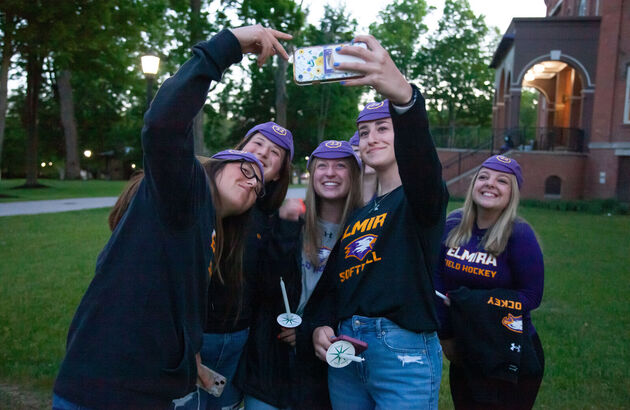
At Elmira, you’ll have opportunities that shape your future, raise your sights and equip you with targeted tools and skills to succeed in the professional world. Join a community that’s close-knit, fun-loving, and just the right amount of quirky.

Elmira College makes a private education more affordable than you realize, with a number of ways to get the financial assistance you may need. Our financial aid office can guide you through options, including scholarships, grants, loans, and work-study programs.

Elmira College includes meeting students from around the world, participating in Elmira traditions, completing community service projects, and hopping into a pickup kickball game.

Elmira College provides you with a foundation for future success.

The home of the three-time NCAA National Champion Elmira College Soaring Eagles.

Elmira College alumni stay connected and engaged with the College long after they graduate.

Gifts to Elmira College ensure excellent academic and co-curricular opportunities for generations of EC students.

Check out our news section to learn about all that's going on at Elmira College.

Looking for registration deadlines, spring break or when grades are due? Our academic calendar has all of the important events for this academic year.

The EC campus map can help you find your way around campus and find the best parking spot.

With over 35 majors and minor areas of concentration, Elmira College lays the foundation for a diverse, cross discipline education, encouraging you to both specialize and explore.

Looking for a small, close-knit campus filled with incredible, hands-on learning opportunities? Our Admissions Office can help make Elmira College YOUR place.
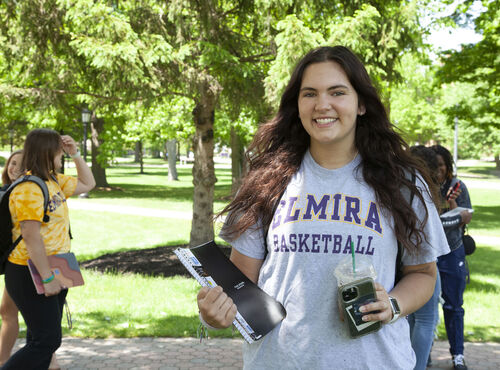
Internal dashboard for EC news, events, resources, and more. Log-in required.
Info For


Elmira College students earn their Applied Prevention Training certification. From left to right, Dr. Larry Parker II, Niall Wildman, Sarah Lundergan, Tania Gonzalez, Eliana Enslow, Naturelle Beam, Allyana Bartram, and Anthony Hooks.
In Term I, a group of Elmira College students attended a new leadership development program called Applied Prevention Training. The four-week program, co-led by EC and CASA-Trinity Inc., taught students how to implement the Stanford Smart Talk Curriculum, which builds substance abuse prevention skills.
While open to all EC students, the program is targeted to those majoring in community-centered degrees such as Social Work, Nursing, Education, and Psychology.
Dr. Larry Parker, Elmira College Director of Social and Cultural Engagement and Title IX Coordinator, partnered with Anthony Hooks, Community Prevention Specialist at CASA-Trinity, to lead the program.
“Our students learned how they can help community members develop communication skills, refusal skills, decision-making, goal-setting, and the ability to handle peer pressure,” explained Parker. “When children and families learn these skills from professionals, they are better able to avoid addictive drugs, unhealthy relationships, and other risky behaviors.”
The following are the first students to complete Applied Prevention Training:
Allyana Bartram ’27, Adolescence Education in Biology
Naturelle Beam '29, Business Administration
Eliana Enslow '28, Speech and Language Disabilities
Tania Gonzalez '28, Psychology
Sheila Kelley '27, Social Work
Sarah Lundergan '29, Business Administration
Niall Wildman '28, Art
Parker said a second group of students is completing the training this Term. He also indicated that future versions will expand to six- to eight-week sessions covering different intervention techniques. CASA-Trinity is a local non-profit that provides addiction prevention, treatment, and recovery services. Its qualified representatives will train the students how to use community interventions related to substance abuse, social and emotional development, and community improvement.


