
Academic Calendar
Looking for registration deadlines, spring break or when grades are due? Our academic calendar has all of the important events for this academic year.


Grounded in the liberal arts and sciences, Elmira College provides a collaborative and supportive environment that enables students to become active learners, effective leaders, responsible community members, and globally engaged citizens.

The legacy of academic excellence at Elmira College runs deep with a heritage and culture that have been forward-thinking from day one, as the first college for women with a course study equivalent to men's.
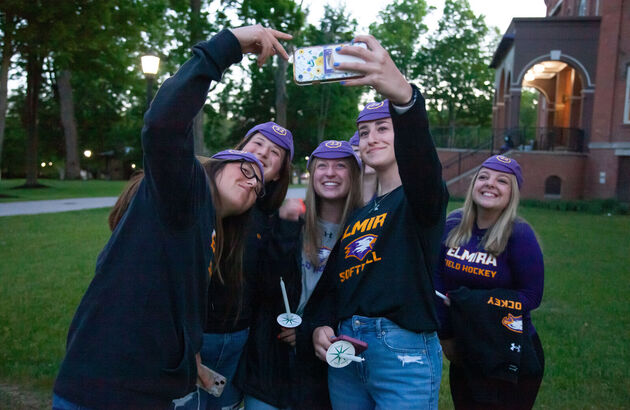
At Elmira, you’ll have opportunities that shape your future, raise your sights and equip you with targeted tools and skills to succeed in the professional world. Join a community that’s close-knit, fun-loving, and just the right amount of quirky.

Elmira College makes a private education more affordable than you realize, with a number of ways to get the financial assistance you may need. Our financial aid office can guide you through options, including scholarships, grants, loans, and work-study programs.

Elmira College includes meeting students from around the world, participating in Elmira traditions, completing community service projects, and hopping into a pickup kickball game.

Elmira College provides you with a foundation for future success.

The home of the three-time NCAA National Champion Elmira College Soaring Eagles.

Elmira College alumni stay connected and engaged with the College long after they graduate.

Gifts to Elmira College ensure excellent academic and co-curricular opportunities for generations of EC students.

Looking for registration deadlines, spring break or when grades are due? Our academic calendar has all of the important events for this academic year.

Looking for a small, close-knit campus filled with incredible, hands-on learning opportunities? Our Admissions Office can help make Elmira College YOUR place.

Check out our news section to learn about all that's going on at Elmira College.

The EC campus map can help you find your way around campus and find the best parking spot.

Internal dashboard for EC news, events, resources, and more. Log-in required.

With over 35 majors and minor areas of concentration, Elmira College lays the foundation for a diverse, cross discipline education, encouraging you to both specialize and explore.
Info For

Please note: Updates to these policies may be made as needed. It is the responsibility of the user to remain informed of policy or their changes.
1.1 To ensure compliance with the Timely Warning requirements of the Jeanne Clery Act and to provide the Elmira College Campus Community, including faculty, staff, and students with timely information about serious emergencies posing immediate or continued threats to the community. Establish criteria for issuance of Emergency Notifications.
1.2 In accordance with the Clery Act, United States Department of Education and the Higher Education Opportunity Act (HEOA), Elmira College will keep the campus community informed by providing timely warnings of Clery reportable crimes occurring on or near campus that represent a serious or continued threat to students, employees and staff.
1.3 Elmira College will also issue Emergency Notifications for other events which do not fall within the Timely Warning criteria but represent a potential threat to the community.
2.1 Timely Warning- An alert to the campus community which consists of a Clery Act reportable crimes occurring within the geography constituting on-campus property that represent a serious or continued threat to students, employees and staff.
2.2 Emergency Notification- An alert to all or portions of the campus community which do not fall within the definition of a Timely Warning but constitute a potential threat to the campus community.
2.3 Clery Act- A federal law with associated regulations administered by the U. S. Department of Education which requires that institutions of higher education September 10th, 2019 provide students, employees, and requesting applicants with an Annual Security Report, which must contain crime statistics concerning specified reportable offenses and other security related information, imposes crime reporting and records keeping requirements on the institutions, and provides for penalties for noncompliance.
2.4 Campus Community- All staff, employees, administrators, and students except new students until the date of move-in whether commuter or resident student.
2.5 Clery Act Reportable Crimes- Murder and non-negligent manslaughter, negligent manslaughter, forcible sex offenses, non-forcible sex offenses, robbery, aggravated assault, burglary, motor vehicle theft, arson, arrests for liquor law violations, drug law violations, illegal weapons possession, and hate crimes to include larceny-theft, simple assault, intimidation, and destruction/damage/vandalism of property if the victim was intentionally selected because of the victim’s actual or perceived race, gender, religion, sexual orientation, ethnicity, or disability.
3.1 Accountability- The Director of Campus Safety or his/her designee will issue Timely Warnings or Emergency Notifications. The Emergency Response Guidelines and Crisis Response Plan outline designated individuals and associated responsibilities for emergency situations.
3.2 Upon receipt of a report of a possible crime being committed or a significant emergency on or off campus which may pose a significant threat to the campus community (e.g., sex assault predator, active shooter, major natural disaster), the Office of Campus Safety will investigate and determine the validity of the report and make appropriate notifications including but not limited to the Assistant Dean of Students, Vice President of Enrollment Management and Student Life, the College President and other pertinent administrators. Upon receipt of this information, with the nature of the event being taken into consideration, the Director of Campus Safety or his/her designee may make appropriate decisions with regards to a “Timely Warning”. Once a determination has been made to issue a “Timely Warning” it will be issued through:
3.3 Timely Warning Considerations
3.4 Emergency Notification Considerations
Examples- (armed intruder on campus, tornado alert, or structure fire on portion of campus)


