
Campus Map
The EC campus map can help you find your way around campus and find the best parking spot.


Grounded in the liberal arts and sciences, Elmira College provides a collaborative and supportive environment that enables students to become active learners, effective leaders, responsible community members, and globally engaged citizens.

The legacy of academic excellence at Elmira College runs deep with a heritage and culture that have been forward-thinking from day one, as the first college for women with a course study equivalent to men's.
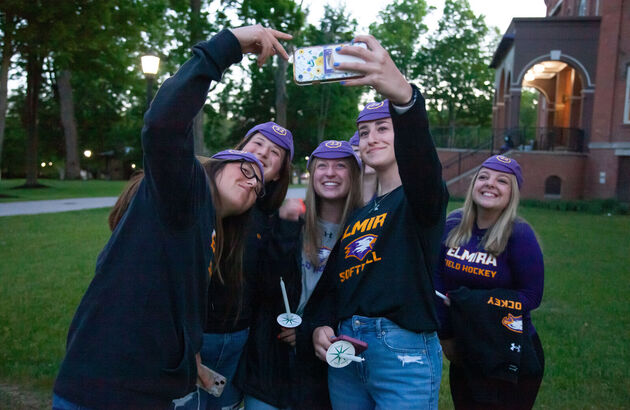
At Elmira, you’ll have opportunities that shape your future, raise your sights and equip you with targeted tools and skills to succeed in the professional world. Join a community that’s close-knit, fun-loving, and just the right amount of quirky.

Elmira College makes a private education more affordable than you realize, with a number of ways to get the financial assistance you may need. Our financial aid office can guide you through options, including scholarships, grants, loans, and work-study programs.

Elmira College includes meeting students from around the world, participating in Elmira traditions, completing community service projects, and hopping into a pickup kickball game.

Elmira College provides you with a foundation for future success.

The home of the three-time NCAA National Champion Elmira College Soaring Eagles.

Elmira College alumni stay connected and engaged with the College long after they graduate.

Gifts to Elmira College ensure excellent academic and co-curricular opportunities for generations of EC students.

The EC campus map can help you find your way around campus and find the best parking spot.

With over 35 majors and minor areas of concentration, Elmira College lays the foundation for a diverse, cross discipline education, encouraging you to both specialize and explore.
Internal dashboard for EC news, events, resources, and more. Log-in required.

Looking for registration deadlines, spring break or when grades are due? Our academic calendar has all of the important events for this academic year.

Looking for a small, close-knit campus filled with incredible, hands-on learning opportunities? Our Admissions Office can help make Elmira College YOUR place.

Check out our news section to learn about all that's going on at Elmira College.
Info For


Several students at Elmira College recently learned their power to effect change. Through their advocacy, EC changed the title of its Women’s Studies minor to Women’s and Gender Studies.
The difference in the program title may seem subtle, but the students wanted the program to better reflect the history of women’s studies programs and the topics they want to learn about.
The issue came up during the Fall Term in Annaliese Hoehling’s WMS 1000 course.
“It became a matter of aligning the name of the minor with the way people discussed the program on campus, and aligning it with what they felt, in this particular class, was a more accurate description of the courses and program,” explained Hoehling, Assistant Professor of English and Director of the Academic Writing Program.
The students felt strongly enough about the importance of the program’s name that they petitioned to make the change official.
Since the name-change required faculty approval, Martha Easton, Associate Professor of Sociology, Social and Behavioral Sciences Chair, submitted the request.
Even before the name change received formal approval, the students wanted to position the change in context to other historical moments in the field of women’s and gender studies.
So, when Hoehling asked the students to update a bulletin board as a final project for the course, her students created a timeline showing some of the history and development of women’s studies programs and disciplines in the United States. At the bottom of the timeline is an entry that says, “Today: Elmira College is changing the name of the minor from Women’s Studies to Women’s and Gender Studies.”
Liv Rubin ’27, a Criminal Justice major with a concentration in Legal Studies and a minor in Women’s and Gender Studies, was among the students to put the timeline together.
“This bulletin board project is significant to me because it showcases the rich history and continual progress of women’s and gender studies programs in America, ultimately leading up to EC’s very own program,” shared Rubin. “We formatted the bulletin board as a timeline for a reason; we wanted to highlight important moments of progress within this field and pay homage to those who have done significant work in advancing women’s rights in academia.”
Rubin said that knowing the history honors the investments made by earlier generations, while reminding her that she is not alone in her activism.
“I immediately felt more connected to the EC community when learning about the history of the Women’s Studies program here,” she said. “This history is a reminder of how far we have come and provides hope that progress will continue to be made.”
In changing the program title, Hoehling's students did something generations of women's studies advocates would recognize. They saw a gap between what something was called and what it actually meant. And then they did something about it.


