
News
Check out our news section to learn about all that's going on at Elmira College.


Grounded in the liberal arts and sciences, Elmira College provides a collaborative and supportive environment that enables students to become active learners, effective leaders, responsible community members, and globally engaged citizens.

The legacy of academic excellence at Elmira College runs deep with a heritage and culture that have been forward-thinking from day one, as the first college for women with a course study equivalent to men's.
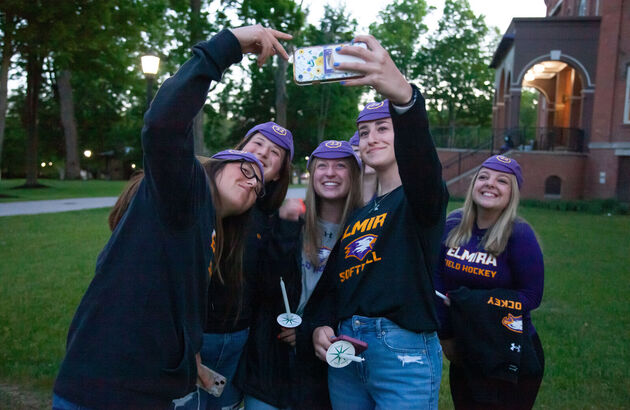
At Elmira, you’ll have opportunities that shape your future, raise your sights and equip you with targeted tools and skills to succeed in the professional world. Join a community that’s close-knit, fun-loving, and just the right amount of quirky.
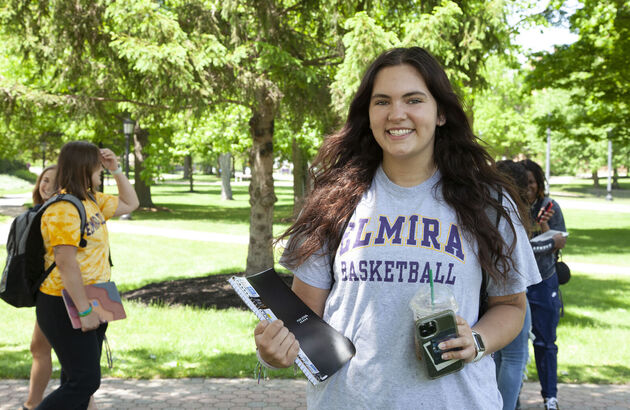
Elmira College makes a private education more affordable than you realize, with a number of ways to get the financial assistance you may need. Our financial aid office can guide you through options, including scholarships, grants, loans, and work-study programs.

Elmira College includes meeting students from around the world, participating in Elmira traditions, completing community service projects, and hopping into a pickup kickball game.

Elmira College provides you with a foundation for future success.

The home of the three-time NCAA National Champion Elmira College Soaring Eagles.

Elmira College alumni stay connected and engaged with the College long after they graduate.

Gifts to Elmira College ensure excellent academic and co-curricular opportunities for generations of EC students.

Check out our news section to learn about all that's going on at Elmira College.

Looking for a small, close-knit campus filled with incredible, hands-on learning opportunities? Our Admissions Office can help make Elmira College YOUR place.

The EC campus map can help you find your way around campus and find the best parking spot.
Internal dashboard for EC news, events, resources, and more. Log-in required.

With over 35 majors and minor areas of concentration, Elmira College lays the foundation for a diverse, cross discipline education, encouraging you to both specialize and explore.

Looking for registration deadlines, spring break or when grades are due? Our academic calendar has all of the important events for this academic year.
Info For


“John Allen, ‘the wickedest man’ and his son Chester” Harper’s Weekly (August 8, 1868)
The public is invited to attend the fall 2023 The Trouble Begins Lecture Series, presented by the Center for Mark Twain Studies and supported by the generous donations of The Mark Twain Foundation. The second free lecture will be at 7:00 p.m., Wednesday, Oct. 18 in the Barn at Quarry Farm with a presentation by Robert E. Cray or Montclair State University.
Entitled, “‘The Wickedest Man in New York?:’ Mark Twain and the 1868 Water Street Sham Revival,” this lecture looks at Mark Twain’s take on a sensational religious event that centered on John Allen, a dance hall owner. Allen’s No. 304 Water Street establishment was among the 1868 Water Street businesses in lower Manhattan that were frequented by sailors seeking entertainment, alcohol, and sex. Journalist Oliver Dyer, an ally of the nearby Howard Mission, described Allen as the “Wickedest Man in New York,” sparking prayer meetings in Allen’s newly closed establishment. The Howard Mission evangelicals displayed Allen as a religious trophy. While many journalists had something to say about the reality of this religious transformation, Twain’s comments underscored his ability to burlesque and parody sensationalized events. According to Cray, Twain did not disappoint.
Robert E. Cray is a Professor of History at Montclair State University, Upper Montclair, New Jersey. His published works include A Notable Bully: Colonel Billy Wilson, Masculinity, and the Pursuit of Violence in the Civil War Era, Lovewell’s Fight: War, Death, and Memory in Borderland New England, and Paupers and Poor Relief: New York City and its Rural Environs, 1700-1830. Cray’s article “Major John Andre and the Three Captors: Class Dynamics and Revolutionary Memory Wars in the Early Republic, 1780-1831,” which appeared in the Journal of the Early Republic, 1997, won the journal’s best article award. He is currently working on religious sensationalism in early Gilded Age New York City.
This year’s series includes a special presentation on Thursday, November 30, by Barbara Snedecor. Entitled “Gravity – A Conversation,” Snedecor will have a conversation with Dr. Matt Seybold, Associate Professor of American Literature and Mark Twain Studies; Director of Media Studies, Communications, and Design; and Resident Scholar at the Center for Mark Twain Studies.
Snedecor served for many years as Director of the Center for Mark Twain Studies at Elmira College and recently edited a volume of selected letters by Mark Twain’s wife, Olivia Louise Langdon Clemens.
The remaining lectures in this year’s Fall Trouble Begins Lecture Series are listed below. All lectures are free and open to the public. Find recordings of previous lectures here.
7:00 p.m., Wednesday, Oct. 18, at the Barn at Quarry Farm: “‘The Wickedest Man in New York?:’ Mark Twain and the 1868 Water Street Sham Revival” by Robert E. Cray of Montclair State University
7:00 p.m., Wednesday, Oct. 25, at the Barn at Quarry Farm: “Mark Twain and the Civil War Memoir Boom” by Stephen Cushman of the University of Virginia
7:00 p.m., Thursday, Nov. 30, Peterson Chapel in Cowles Hall on the Elmira College campus: “Gravity — A Conversation” by Barbara Snedecor in conversation with Matt Seybold, Elmira College Center for Mark Twain Studies
In 1984, the Elmira College Center for Mark Twain Studies initiated a lecture series, The Trouble Begins at Eight lecture series. The title came from the handbill advertising Mark Twain's October 2, 1866 lecture presented at Maguire's Academy of Music in San Francisco. The first lectures were presented in 1985. By invitation, Mark Twain scholars present lectures in the fall and spring of each year, in the Barn at Quarry Farm or at Peterson Chapel in Cowles Hall on Elmira College's campus. All lectures are free and open to the public.


